



Among the more puzzling cosmic phenomena discovered over the past few decades are brief and very bright flashes of blue and ultraviolet light that gradually fade away, leaving behind faint X-ray and radio emissions. With slightly more than a dozen discovered so far, astronomers have debated whether they are produced by an unusual type of supernova or by interstellar gas falling into a black hole.
Analysis of the brightest such burst to date, discovered last year, shows that they're neither.
Instead, a team of astronomers led by researchers from the University of California, Berkeley, concluded that these so-called luminous fast blue optical transients (LFBOTs) are caused by an extreme tidal disruption, where a black hole of up to 100 times the mass of our sun completely shreds its massive star companion within days.
The discovery resolves a decade-long conundrum but also illustrates the many varieties of stellar calamities that astronomers encounter, each with its characteristic spectrum of light—different wavelengths, different intensities—that evolves over time. Figuring out the processes that produce these unique light signatures tests current knowledge of the physics of black holes and helps astronomers understand the evolution of stars in our universe.

Intermediate-mass black holes and their mysteries
The inferred mass of the black hole—in a range sometimes referred to as intermediate-mass black holes—is also intriguing for astronomers. While black holes of more than 100 solar masses are known to exist because their mergers have been detected by gravitational wave experiments like the Laser Interferometer Gravitational-Wave Observatory (LIGO), they've never been directly observed and how they grow to that size is still a mystery. Study of this and similar events could shed light on the stellar environment in which large black holes evolve alongside a massive stellar companion.
"Theorists have come up with many ways to explain how we get these large black holes, to explain what LIGO sees," said Raffaella Margutti, UC Berkeley associate professor of astronomy and physics.
"LFBOTs allow you to get at this question from a completely different angle. They also allow us to characterize the precise location where these things are inside their host galaxy, which adds more context in trying to understand how we end up with this setup—a very large black hole and a companion."
Discovery and naming of LFBOTs
LFBOTs got their name because they are bright—they're visible over distances of hundreds of millions to billions of light-years—and last for only a few days, producing high-energy light ranging from the blue end of the optical spectrum through ultraviolet and X-ray.
The first was seen in 2014, but the first with sufficient data to analyze was recorded in 2018 and, per the standard naming convention, was called AT 2018cow. The name led researchers to refer to it as the Cow, and subsequent LFBOTs have been called, tongue in cheek, the Koala (ZTF18abvkwla), the Tasmanian Devil (AT2022tsd) and the Finch (AT2023fhn).
The newest LFBOT, named AT 2024wpp (the Woodpecker, perhaps?), is analyzed in two papers recently accepted by The Astrophysical Journal Letters. UC Berkeley postdoctoral fellow Nayana A.J. is first author of an analysis of X-ray and radio emissions from AT 2024wpp, while Berkeley graduate student Natalie LeBaron is first author of an analysis of the optical, ultraviolet and near infrared emissions. Margutti is the senior author of both papers. Both papers are available on the arXiv preprint server.
Energy calculations and supernova theories
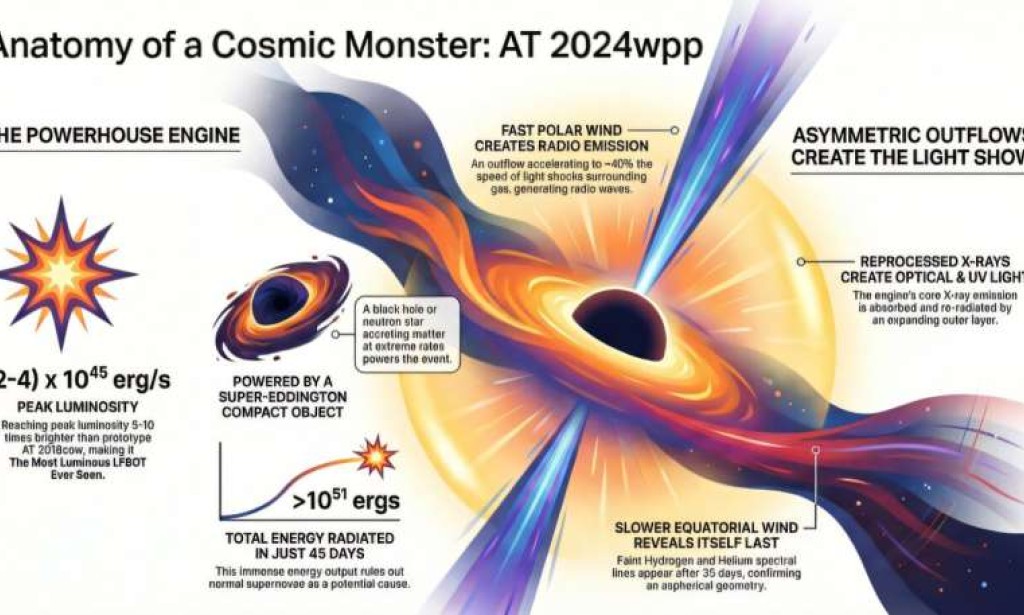
The realization that the transient outburst could not have resulted from a supernova came after the researchers calculated the energy emitted. It turned out to be 100 times greater than what would be produced in a normal supernova, which would require the conversion of about 10% of the rest-mass of the sun into energy over a very short time scale, mere weeks.
"The sheer amount of radiated energy from these bursts is so large that you can't power them with the collapse and explosion of a massive star—or any other type of normal stellar explosion," LeBaron said. "The main message from AT 2024wpp is that the model that we started off with is wrong. It's definitely not caused by an exploding star."
The tidal disruption process explained
The researchers hypothesize that the intense, high-energy light emitted during this extreme tidal disruption was a consequence of the long parasitic history of the black hole binary system. As they reconstruct this history, the black hole had been sucking material from its companion for a long time, completely enshrouding itself in a halo of material too far from the black hole for it to swallow.
Then, when the companion star finally got too close and was torn apart, the new material became entrained into a rotating disk of debris, called an accretion disk, and slammed against the existing material, generating X-ray, UV and blue light.
Much of the gas from the companion also ended up swirling toward the poles of the black hole, where it was ejected as a jet of material. They calculated that the jets were traveling about 40% of the speed of light and generated radio waves when they encountered surrounding gas.
Details about the companion star and environment
The estimated mass of the companion star that was shredded was more than 10 times the mass of the sun. It may have been what's known as a Wolf-Rayet star, which are very hot and evolved, having already used up much of their hydrogen. This would explain the weak hydrogen emission from AT 2024wpp.
Like most LFBOTs, AT 2024wpp is located in a galaxy with active star formation, so large, young stars like these are expected. AT 2024wpp is 1.1 billion light-years away and between five and 10 times more luminous than AT 2018cow.
Observational tools and future prospects
A large collection of telescopes was used to measure the various wavelengths of light emitted by the LFBOT. These included three X-ray telescopes, NASA's Chandra X-ray Observatory, Swift-XRT and the Nuclear Spectroscopic Telescope Array (NuSTAR); radio telescopes such as the Atacama Large Millimeter/submillimeter Array (ALMA) and CSIRO's Australia Telescope Compact Array (ATCA); the Ultra-Violet/Optical Telescope (UVOT) on NASA's Neil Gehrels Swift Observatory; and ground-based optical telescopes, including the Keck, Lick and Gemini Observatories.
Because LFBOTs produce copious amounts of UV, the researchers are looking forward to the launch of two planned UV telescopes—ULTRASAT and UVEX, which involves numerous Berkeley scientists and will be operated by the Space Sciences Laboratory—in the coming years. These telescopes will be critical for discovering and rapidly characterizing more LFBOTs before they reach peak brightness, allowing astronomers to systematically probe the diversity of their environments and progenitor systems.
"Right now, we find only about one LFBOT per year. But once we have UV telescopes in place in space, then finding LFBOTs will become routine, like detecting gamma ray bursts today," Nayana A.J. said.

You must be logged in to post a comment.