



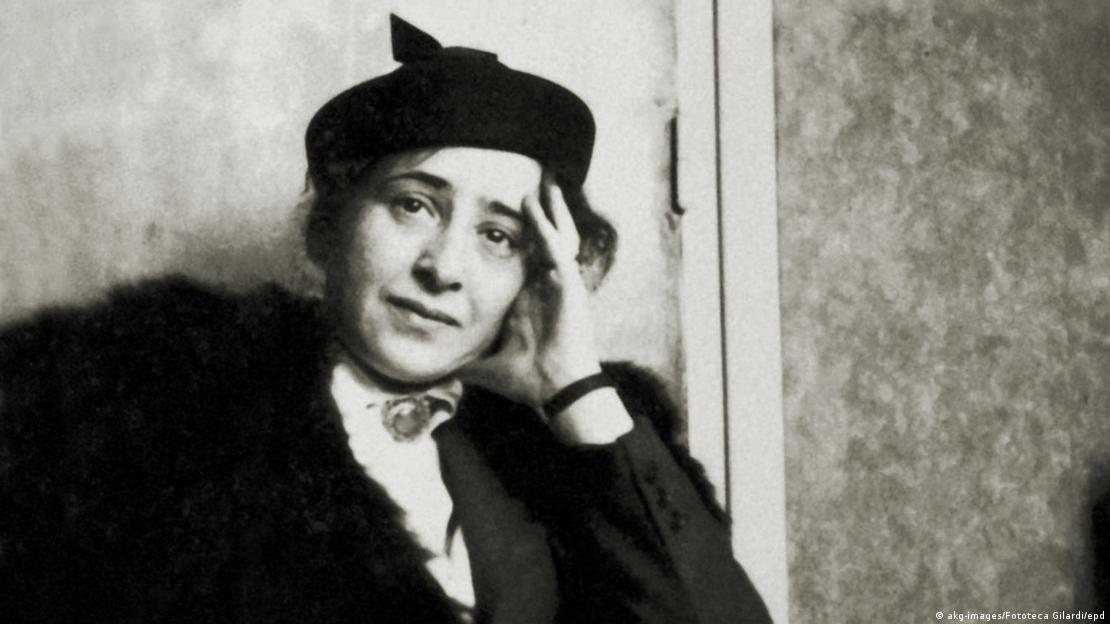
Hannah Arendt, photographed in 1969.Image source: AP/picture alliance
(Deutsche Welle Chinese) The voice of an artist played loudly and repeatedly from loudspeakers. A model house, about the size of two shoeboxes, stood in the exhibition hall. It had no roof, its doors and windows wide open, offering no protection against outside intrusion. This was part of an exhibition in Beijing commemorating the 50th anniversary of Hannah Arendt's death. Is it a metaphor for the constant barrage of voices in our time? Or does it refer to the disappearance of personal space under China's ubiquitous surveillance and propaganda? People can have their own interpretations. But one cannot avoid reflecting on Arendt, the political theorist: her description of humanity—lost between fact and fiction.
The exhibition, titled " Under the Stars ," was held at the Goethe-Institut. Compared to the Chinese art and cultural scene, it offered a much larger space. Curator Yao Siqing stated that in times of darkness, we need the stars in the sky, and Hannah Arendt was such a star, just like the people depicted in her book, *Men in the Dark Ages*. It concerns spiritual independence and courage.
"Hannah Arendt's ideas have a healing effect. She believed that every new person has a unique meaning, or brings something new to the world, which brings possibilities," the curator described Hannah Arendt's key significance.

Arendt's biography (Chinese version)
Thomas Meyer's biography of Hannah Arendt has just been translated into Chinese. A few weeks ago, he traveled to China to promote the book. He visited several Chinese cities and gave lectures at universities. At an event at the Goethe-Institut in Beijing, he signed copies of the book one after another, attracting many interested young people.
Thomas Meyer said, “I had no expectations before I came to China, but I was thrilled by the openness and—how should I put it—the tangible interest and sometimes the profound understanding. I had spent two weeks in Latin America before, visiting Uruguay, Chile and Argentina. In terms of questions and responses, I saw no difference.”
On the 50th anniversary of Arendt's death, a collection compiled by Chinese scholars specializing in Arendt studies has been published. Her books, *Eichmann in Jerusalem* and *The Origins of Totalitarianism*, are listed on Douban. A famous conversation between German journalist Günter Gauss and Arendt can be found on Chinese social media.
Nevertheless, censorship in China is extremely strict. "The Origins of Totalitarianism" is no longer being reprinted. Any criticism of the system is dangerous and forbidden. Many people have left the country as a result. The Chinese people have become accustomed to expressing themselves using coded language and metaphors in order to at least enjoy some degree of intellectual freedom and draw strength from it. Universities are heavily monitored; Thomas Mayer had to submit prepared speeches beforehand. However, he also had considerable room for improvisation in the lecture hall, sometimes touching on Hannah Arendt's major works on totalitarianism.
Thomas Meyer said, “We were talking about history, about Arendt, but at the same time, we both knew—and this is my very clear impression—that we tacitly knew what we were really talking about.”
r freedom
How could a regime that suppresses dissent tolerate Hannah Arendt? Thomas Mayer's answer is intriguing. He argues that one reason is the desire to know what the opponent is thinking. What, then, is the foundation of liberal democracy? "Because a society cannot be satisfactorily analyzed solely from the perspective of capitalism." Furthermore, the Chinese authorities clearly have a certain tolerance for ambiguity, stemming from sufficient confidence: "This is a moment the regime can afford to demonstrate its power." This regime, with its sophisticated digital surveillance system, can nip even the slightest resistance in the bud, silencing it completely. But Hannah Arendt's thought is so profound, touching upon the essence of human existence and self-positioning in the world, as well as maintaining inner freedom in an unfree external world. At least, this is how these young readers can be understood:
"We connect through social media, but that's not a real dialogue. What Arendt called for was more participation in public life, expression and communication in public spaces, thereby creating space for existence and understanding the world. I think Arendt's most valuable qualities were her positive thinking and optimism. Arendt brought the idea of public space into the modern era. She rebuilt our enthusiasm and trust in the future."
This is called "Thinking—as the Home of the Spirit." It is about a stance, a stance on the world that people live in and cannot change.

You must be logged in to post a comment.