



Image source,Getty Images
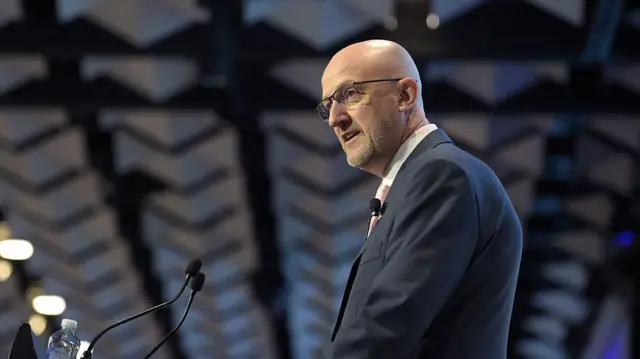
Image captioningBurgess stated that infrastructure such as water and transportation networks have become targets of hacking attacks linked to China. Article Information
-
- AuthorLana Lam
- Role,Sydney
-
November 13, 2025Last updated: November 13, 2025
The head of Australia's intelligence agency said hackers linked to the Chinese government and military are targeting the country's critical infrastructure and warned that Australia is increasingly facing the risk of "high-impact sabotage".
Mike Burgess, director of the Australian Security Intelligence Organisation (ASIO), pointed out that "unprecedented espionage" means that the threat of "cyber-driven sabotage" will continue to rise over the next five years.
He specifically named "a certain country—which is not hard to guess—that has repeatedly attempted to scan and infiltrate Australia's and its allies' critical infrastructure," targeting water, transportation, telecommunications, and energy networks.
The Chinese Embassy has been contacted for comment.
Burgess warned that authoritarian regimes are now more inclined to "destruction and ruin." He cited two Chinese hacking groups—Salt Typhoon and Volt Typhoon—that had targeted telecommunications companies in the United States and Australia.
He stated at a business forum in Melbourne: "These groups are hackers working for the Chinese government's intelligence agencies and military."
"Both involve stealing sensitive information, but the real danger lies in the threat of disruption—interference with critical infrastructure." He pointed out that Salt Typhoon's purpose was espionage, including hacking into U.S. telecommunications networks.
"And they are also probing our Australian telecommunications networks," Burgess said, adding that Volt Typhoon's operation was intended to create disruption, and that hackers had infiltrated critical U.S. infrastructure networks in preparation for potential future damage.


"Yes, we are also seeing Chinese hackers probing our critical infrastructure," Burgess said.
He warned that authoritarian regimes are increasingly willing to destroy critical infrastructure in order to "hinder decision-making, damage the economy, weaken military capabilities and sow discord in society."
"I don't think we—I mean all of us—truly understand how destructive and devastating this could be," he said.
Burgess pointed out that even brief telecommunications outages unrelated to foreign interference have had significant and widespread impacts on society. "That was just a telecommunications network going down for less than a day," he said.
"Imagine if a country shut down all its networks? Or cut off power during a heatwave? Or contaminate drinking water? Or paralyze the financial system?" Burgess said, adding that spies are "expanding their intelligence-gathering scope."
"They actively target private sector projects, negotiations, and investments, potentially giving foreign companies a business advantage. And like criminals, they actively target customer data."
Burgess points out that conservative estimates show that espionage activities will cost Australia AU$12.5 billion (approximately US$8.2 billion; £6.2 billion) in 2023-24, including approximately US$2 billion in stolen trade secrets and intellectual property within a year.
He described these hackers' capabilities as "extremely sophisticated, using cutting-edge technology to find your network, test vulnerabilities, attack digital doors, and inspect digital locks."
"Once they infiltrate your network, they will actively map the system and seek to maintain continuous and undetected access so that they can carry out sabotage at a time and place of their choosing."

You must be logged in to post a comment.