

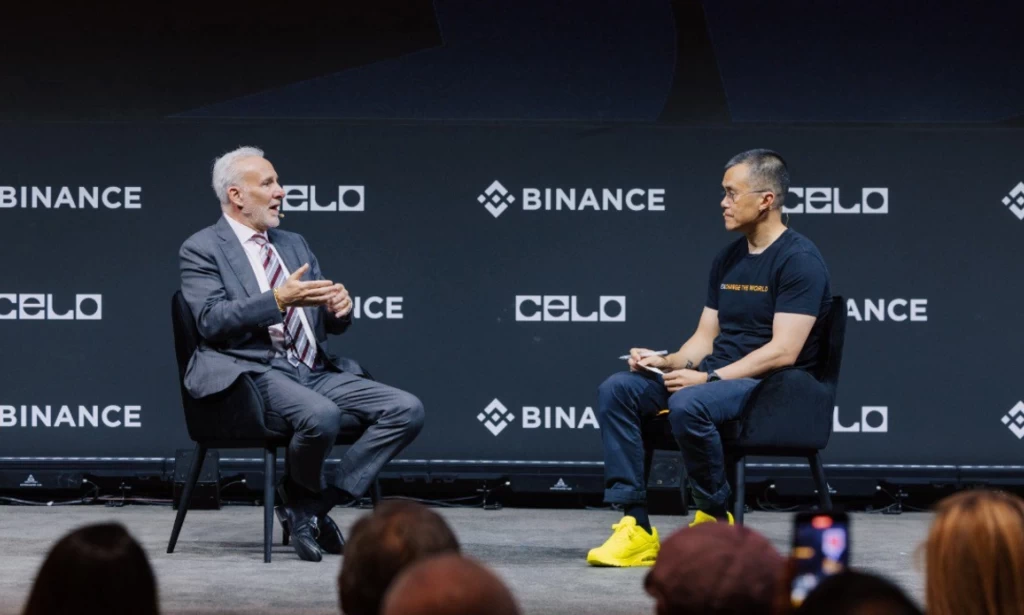

A highly anticipated debate between precious metals advocate Peter Schiff and Binance founder Changpeng Zhao (CZ) reignited fundamental questions about Bitcoin's purpose today, unfolding at a uniquely challenging moment for the cryptocurrency markets.
Hours before the session began, hundreds queued to enter the packed main hall at Binance Blockchain Week in Dubai. But what began as a respectful discussion quickly evolved into a familiar, if sharper dispute: is Bitcoin a transformative economic force, or a speculative bubble that has already popped?
The backdrop: A 27% correction
The debate crystallized long-standing concerns about Bitcoin's viability, amplified by recent price action. BTC has fallen 27% from its 6 Oct all-time high above $126,000, driven by macroeconomic uncertainty and anxiety over AI-focused equities. In the same period, the S&P 500 gained 1.4% and gold rose 5.6%.
Schiff seized on this divergence, arguing that Bitcoin holders will eventually pivot en masse to gold, triggering a total collapse. He contrasted gold's recent gains against the unfulfilled "moon" predictions of early 2025.
“I think gold will do well, but I think Bitcoin will do even better,” CZ countered, predicting continued growth despite the correction. He emphasized that Bitcoin's market cap of $2-3tn proces it is already a global asset class, far exceeding altcoins and destined to outperform the metal eventually.

The utility trap
The most contentious issue was whether Bitcoin has any practical use at all. Echoing recent comments by ECB President Christine Lagarde, Schiff dismissed Bitcoin as having "price", but no "value".
"Nothing is actually priced in Bitcoin," Schiff argued. "No goods, services or salaries are quoted in cryptocurrency. Even employees receiving Bitcoin pay slips are earning dollar-denominated salaries temporarily converted to crypto."
CZ pushed back, citing Binance employees who receive Bitcoin salaries pegged to dollar amounts from years ago, effectively earning in "hard money." He also argued that crypto transactions save time and fees in developing nations, particularly in Africa. To demonstrate payment utility, CZ summoned a Binance Visa card from an audience member.
"My point is that people are already using crypto as payments," he said. "No, they're not. They're using it as collateral," Schiff retorted.
Crypto adoption is continuing to grow. Major US retailers like Bealls are rolling out crypto payments across 660 physical stores, while infrastructure operators are aggressively expanding into financial hubs like Hong Kong. The physical footprint is undeniable: global crypto ATM installations have surged from just nine in 2013 to over 37,700 this year, with Fortune Business Insights projecting the market will grow 55% annually through 2032.
Common ground?
The exchange was far more engaging than the typical promotional panels at crypto events, primarily because the combatants found virtually no common ground until the final moments.
Schiff characterized Bitcoin purchases as "lottery tickets", warning of disaster when investors "stop believing in this fantasy." Yet the debate ended on a conciliatory note, with Schiff proposing to list his future tokenized gold product on Binance's BNB chain.
CZ wished him success, perhaps recognizing that in a world of $93,000 Bitcoin, there is room for both digital gold and the real thing.

You must be logged in to post a comment.