

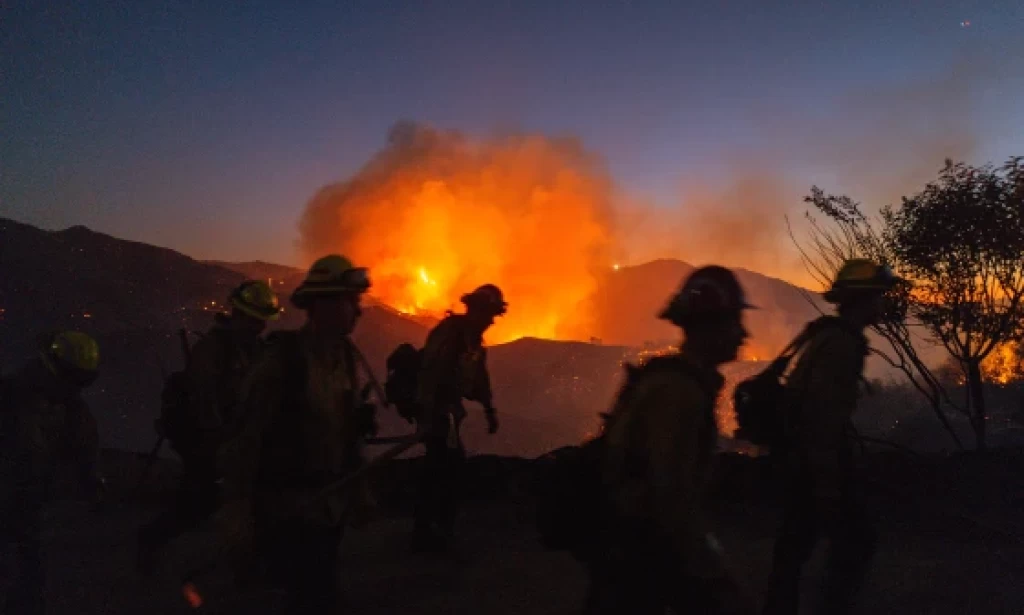

Pregnant women's exposure to wildfire smoke — particularly in the third trimester — may increase the risk of autism in their children, according to new research, which looked at hundreds of thousands of births in Southern California.
 The study, published Tuesday in the journal Environmental Science & Technology, is the first to examine a potential link between prenatal wildfire smoke exposure and autism. Earlier research has suggested that pregnant women's exposure to air pollution more broadly, including smog spewed by vehicles, smoke stacks and lead, may be linked to the developmental disorder.
The new research focused on exposures to PM 2.5, tiny particles in wildfire smoke that can lodge deep in the lungs and enter the bloodstream, which has raised major health concerns. To estimate smoke exposure, researchers used a model to estimate levels of PM 2.5 at each individual’s home address during their pregnancy.
“This paper supports other scientific research that links prenatal exposure to air pollution, particularly PM 2.5 to autism,” said Alycia Halladay, chief science officer at the nonprofit Autism Science Foundation, who was not involved in the study. “The size of the risk is not huge, but it is consistent with other research and adds to a body of scientific literature linking air pollution and autism.”
“Both autism and wildfires are on the rise, and this study is just the beginning of investigating links between the two,” said senior study author Mostafijur Rahman, an assistant professor of environmental health sciences at Tulane University’s Celia Scott Weatherhead School of Public Health and Tropical Medicine.
How big is the risk?
The study analyzed health records of more than 200,000 births in Southern California from 2006 through 2014. California, the researchers said, leads the country in both yearly acres burned by wildfire and rates of childhood autism diagnoses.
The increased risk was strongest when mothers were exposed to wildfire smoke during the third trimester (the last three months of pregnancy), especially during stretches of multiple smoky days, rather than from overall average pollution levels alone, the study found.
The risk of autism diagnosis was about 10% higher for children whose mothers experienced 1 to 5 smokey days in the third trimester, 12% higher with 6 to 10 days and 23% higher with more than 10 days.
The association was clearest among women who didn’t change residences during pregnancy, suggesting that sustained exposure in the same location — not just occasional smoke — may play an important role.
The study, however, doesn’t explain why wildfire smoke may increase autism risk.
Rahman said wildfire smoke is quite different from other pollutants, such as traffic pollutants, that people are exposed to on an almost everyday basis.
“Wildfire smoke has a unique chemical composition,” he said, “including higher levels of carbon compounds, metal, toxic byproducts, and it tends to occur in intense and short term spikes.”
The third trimester is a critical period in a fetus’s development, said lead study author David Luglio, a post-doctoral fellow with the Celia Scott Weatherhead School.
“In terms of the brain, and the late trimester, this is when the brain really grows in size and develops its main centers,” he said. He added that the findings shouldn’t cause alarm, noting that autism isn’t limited to environmental factors, but is also believed to have a strong genetic component.
Halladay said exposure to high levels of PM 2.5 have already been linked to lower birthweight, higher levels of preterm births, asthma and obesity.
“So close monitoring, as well as mitigation of air pollution, should be a priority for regulatory agencies going forward,” she said.

You must be logged in to post a comment.