


Introduction: The Global Allure of Korea’s Cultural Identity
Korean culture has emerged as a global phenomenon, captivating audiences worldwide through its vibrant blend of ancient traditions and modern innovation. From the soul-stirring melodies of K-pop to the intricate artistry of traditional hanbok, Korea’s cultural landscape is a rich tapestry woven from centuries of history, unique social values, and a distinct aesthetic philosophy. This article delves into the core elements that define Korean national culture, highlighting how these features create a cultural identity that is both deeply rooted and dynamically evolving.
1. Language as a Cultural Cornerstone: The Beauty of Hangeul
1.1 The Ingenious Design of the Korean Alphabet
Developed in 1446 by King Sejong the Great, Hangeul stands as one of the most scientific writing systems in the world. Composed of 24 letters (10 vowels and 14 consonants), it was designed to be accessible to all classes, reflecting Korea’s historical emphasis on education and equality. Unlike logographic scripts, Hangeul’s phonetic structure mirrors the sounds of the Korean language, making it remarkably efficient for both reading and writing. This linguistic innovation not only preserved Korea’s cultural autonomy but also became a symbol of national pride. Today, Hangeul remains a vital tool in spreading Korean culture globally, appearing in K-drama subtitles, K-pop lyrics, and even modern digital media, where its sleek, geometric forms enhance visual storytelling.
1.2 Language as a Marker of Social Hierarchy and Respect
Korean language etiquette, known as jondaenmal, embodies the country’s hierarchical social values. The use of honorifics—such as formal speech levels (jondaenmal) for elders or superiors and casual speech (banmal) among peers—reflects a deep-rooted respect for age and status. This linguistic nuance is not just a grammatical feature but a cultural code that governs daily interactions, emphasizing harmony and social order. Mastery of these subtle distinctions is essential in both personal relationships and professional settings, showcasing how language serves as a bridge between tradition and modernity in Korean society.
2. Etiquette and Social Values: The Art of Harmony
2.1 Respecting Age and Hierarchy: The Foundation of Mannerisms
Korean culture places profound importance on hyo (filial piety) and jung (interpersonal loyalty), principles that shape social conduct. A key manifestation is the practice of bowing, where the depth and duration of the bow signal respect for elders or authority figures. For example, a younger person will bow deeper and hold it longer when greeting an older relative or teacher, while peers might exchange a slight nod. This ritual is not mere formality but a living expression of collective responsibility, reinforcing the idea that individual behavior impacts the harmony of the group.
2.2 Dining Etiquette: A Reflection of Community and Gratitude
Mealtime in Korea is a communal experience governed by precise etiquette. For instance, one should not start eating until the eldest person at the table begins, and chopsticks and spoons are used with specific rules—spoons for rice and soup, chopsticks for solids—to maintain cleanliness and respect. The act of sharing banchan (side dishes) and offering food to others embodies the value of bunmyeong (distributing resources fairly), turning meals into opportunities to strengthen social bonds. These customs highlight how everyday actions in Korea are infused with cultural meaning, transforming routine into ritual.
3. Traditional Arts: Preserving Heritage Through Creativity
3.1 Dance and Music: Stories in Motion and Sound
Korean traditional dance, such as buchaechum (fan dance) and jultagi (acrobaltic dance), combines elegance with symbolic storytelling. The fluid movements of bucheong, for example, mimic the fluttering of butterflies or the flow of water, embodying nature’s beauty and the Confucian ideal of balance. Accompanying these dances is gugak (traditional music), featuring instruments like the gayageum (zither) and janggu (drum). The rhythmic beats of samulnori (four-percussion ensemble) not only entertain but also connect audiences to agricultural traditions, as the rhythms were historically used to coordinate labor in the fields. These art forms serve as living archives, preserving Korea’s rural and philosophical heritage.
3.2 Craftsmanship: The Poetry of Handmade Art
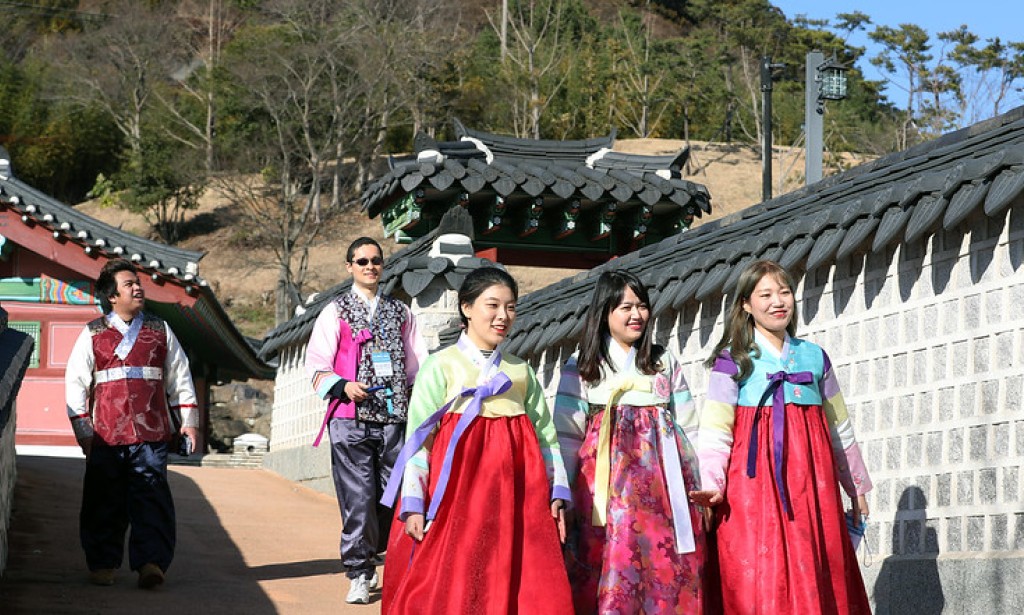
Korean pottery, particularly celadon and white porcelain, is celebrated for its minimalist elegance and technical precision. Celadon’s soft green glaze, perfected during the Goryeo Dynasty, symbolizes the harmony between man and nature, while Joseon-era white porcelain reflects the Neo-Confucian emphasis on simplicity and purity. Similarly, hanbok, the traditional attire, features vibrant colors and flowing lines tailored to the Korean climate and social status—bright hues for festivals, muted tones for formal occasions. Each stitch and glaze in these crafts is a testament to Korea’s reverence for craftsmanship, where utility and aesthetics are seamlessly intertwined.
4. Culinary Culture: Flavors as a Cultural Language
4.1 Kimchi: The Fermented Heart of Korean Cuisine
No discussion of Korean food is complete without kimchi, a fermented vegetable dish (typically napa cabbage) flavored with chili, garlic, and ginger. More than a side dish, kimchi is a cultural icon, with families often preparing it together in the autumn (main season) as a communal activity. Rich in probiotics and symbolic of resilience (it thrived in Korea’s harsh winters), kimchi represents the country’s ability to transform simple ingredients into something profound. Its pungent aroma and bold taste have become synonymous with Korean identity, even inspiring global culinary trends.
4.2 Balancing Flavors and Philosophy: The Art of Hanjeongsik
Hanjeongsik, a full-course traditional meal, showcases Korea’s holistic approach to food. Comprising rice, soup, kimchi, and an array of banchan, each dish is meticulously arranged to balance colors, textures, and flavors—spicy, salty, sweet, and umami—reflecting the Confucian principle of eum-yang (yin-yang) harmony. The presentation itself is a visual art, with small, shared plates encouraging social interaction. Even modern Korean cuisine, from street food like tteokbokki (spicy rice cakes) to fusion creations, builds on this foundation, proving that food in Korea is both a tradition and a living, evolving expression of culture.
5. Modern Cultural Waves: Shaping Global Trends
5.1 K-pop and K-drama: The Soft Power Dynamo
K-pop, led by groups like BTS and BLACKPINK, has transcended music to become a global cultural phenomenon. Known for its polished choreography, multilingual lyrics, and innovative concepts, K-pop blends Western pop influences with Korean musicality, creating a unique sound that appeals to diverse audiences. The synchronized dance moves of BTS in their hit song "Dynamite" not only showcase their artistic talent but also set new standards for stage performances globally. Similarly, K-dramas, with their compelling narratives and high production values (e.g., *Cr
Conclusion: A Culture of Contrasts and Connections
Korean culture thrives in the interplay between its storied past and its dynamic present. From the scientific elegance of Hangeul to the global dominance of K-pop, each feature explored here—language, etiquette, art, food, and modern trends—reveals a society that honors its roots while embracing innovation. As a global cultural hub, Korea teaches us that tradition is not static but a living, breathing entity, constantly evolving to connect with new audiences. In a world growing increasingly interconnected, the unique tapestry of Korean culture serves as a bridge, inviting us to appreciate both its timeless treasures and its ever-evolving spirit.

You must be logged in to post a comment.