

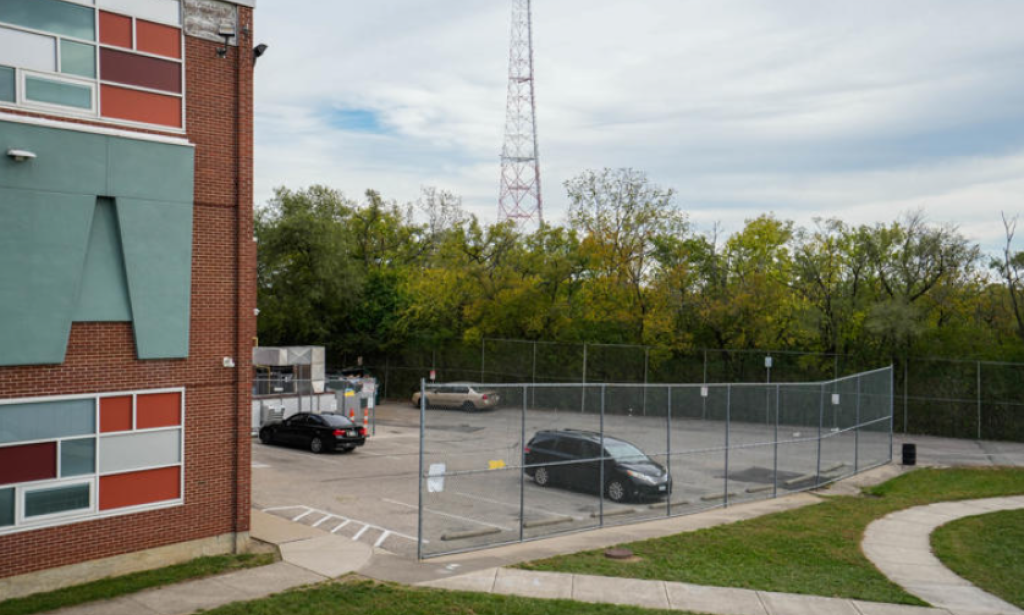

They knew the basics. In July 2020, a Syrian intelligence officer had summoned the 60-year-old imam and asked him to help mediate a dispute between two local families. When Kharouf arrived at the appointed location, agents stuffed him into the back of a truck and drove him to a walled security complex in the city center.
There, in a basement prison not far from luxury restaurants and hotels, the imam died, the family would learn later that year. They never received his body.
An explanation emerged last month when they read for the first time part of Kharouf’s state security file, which was among thousands of pages of Syrian military intelligence documents discovered by The Wall Street Journal. The files were part of a yearlong investigation into crimes committed by the regime of former President Bashar al-Assad. Opposition forces overthrew Assad, who fled to Russia, in December 2024.
The documents said Kharouf was arrested in an investigation that included testimony from one of his own relatives—a distant cousin, who intelligence officers said gave up the imam’s name during an interrogation in the same basement after he was detained that same summer.
The cousin, a former rebel fighter, accused Kharouf of aiding the opposition to Assad, the document said, even though Kharouf’s immediate family said he avoided politics for years after a brief period of initial support for the uprising that began in 2011, dutifully reading out government-approved sermons every Friday at the city’s Ikhlas Mosque.
The cousin, Mahmoud Kharouf, strongly denied in an interview that he ever mentioned the imam’s name, even during the weeks that security officers tortured him inside the prison. His denials did little to convince Abdu Kharouf’s family, who have refused to speak to the cousin for years.
The case is one of hundreds uncovered by the Journal that reveal new details about the brutal surveillance system built by the Assad regime to maintain its grip on power.
Like the Stasi of East Germany and Stalin’s secret police, it thrived on instilling fear at an almost molecular level in Syrian society, turning neighbors, friends and spouses against one another.
Once ensnared by the secret police, many victims vanished for good: More than 160,000 people were forcibly disappeared by the Assad regime since 2011, according to a count by the Syrian Network for Human Rights. Assad’s industrialized machinery of death killed many thousands who were then buried in mass graves, according to U.S. and Syrian war crimes investigators, human rights groups, U.N. documentation and the Journal’s own investigations.
Syrians are only now starting to make sense of the trauma and paranoia caused by the system a year after the regime’s collapse. Many still question whom they can trust, and who informed on whom.
Syria’s new government said it is planning to investigate the Assad regime’s abuses, but a full accounting would be a vast undertaking that has yet to begin in earnest.
The Journal’s reporting has started to pull back the veil on the system, thanks to more than a thousand pages of documents from Syrian military intelligence reviewed and photographed inside the Kafr Sousah security complex near the city’s famed Umayyad Square.
Some of the files were found stashed in a hidden repository discovered when rebels punched through a brick wall when they seized the building. Other files were piled on the desks of intelligence officers who fled the compound days earlier, leaving behind guns, empty bottles of Scotch, extinguished cigarettes and half-drunk glasses of tea as rebels closed in on the capital on Dec. 8, 2024.
The documents show how Assad’s four main intelligence agencies spied on peaceful activists, militants, visiting diplomats, United Nations staff and even on each other. They detailed what they considered to be crimes, including carrying U.S. dollars, possessing unregistered SIM cards and speaking against the government, even in private.
The intelligence officers scribbled notes on wiretapped phone calls and typed thousands of pages of reports on opposition activities. They fielded reports from other branches of the security services and from a network of spies throughout Syria, the Middle East and Europe. The documents include confessions extracted under torture, which the Journal confirmed through interviews with people named in the papers.
Among the cases in the documents verified by the Journal: A prominent actor whose own wife was asked to put off plans to divorce him and instead secretly record his conversations; a government spy who was recruited to keep tabs on a diplomatic conference in Prague; and a teenager who was tortured into a false confession that he joined an armed group.
Faysal Itani, a Syrian-Lebanese political analyst whose name appeared in the documents for his role in organizing the Prague conference, said he grew up with a constant awareness of the Syrian mukhabarat, or secret police, all around him.
“They’ve always just been there,” said Itani, who now works for the New Lines Institute in Washington. “For me it’s scarcely believable that the regime isn’t there anymore. It’s like losing a friend that I hate, just disappeared after 30 years.”
The documents also show how Assad’s intelligence agents encouraged Syrians to report on each other, leaving behind a legacy of distrust.
Family betrayal
Firas Al-Faqir, an actor with a baritone voice, initially supported the protests against the Assad regime and signed an artists’ statement calling for government reforms. But he backed away when the regime launched its deadly clampdown, continuing to work at a state TV building where he filmed Ramadan soap operas and a morning talk show.
At home, however, he continued to vent his frustrations with the government to his wife, Hala Deeb. In one dinner-table conversation in early 2020 with Hala and her mother, he unloaded about the state’s dependence on Russia and Assad’s handouts to business elites.
In the spring of 2020, Hala abruptly demanded a divorce, he said. Staying close to her family in the Mediterranean city of Tartus during the Covid-19 pandemic, she sent him a voice message, playing back a piece of his diatribe that had been secretly recorded. She wanted money, she said, or she would send the recordings to the secret police.
The intelligence documents show that soon after, Hala did hand over at least one recording. A report dated July 2020 said military intelligence received information that Faqir was speaking against the government in his home, listing his criticisms of the regime. It said his wife wanted a divorce “because she cannot tolerate talk that offends the Senior Political Leadership.”
The security service directed a source to persuade her to postpone the divorce in order to gather more information on the actor, the document said.
Unaware of the secret report but now anxious that he was under surveillance, Faqir saw Hala and her family one last time in Tartus later that summer. “Why are you speaking against the president?” he recalled Hala asking. Faqir denied to her ever criticizing the government.
A few weeks later, Faqir said, his boss called him to his office, where an intelligence officer was waiting. Faqir told the officer his wife had filed a false complaint against him. The officer took notes and left.
Security men showed up to question him at least twice more. Faqir then mostly stayed in his apartment, terrified he would be arrested if he went to work. A glimmer of hope came when a military doctor he once interviewed on a TV show offered to intervene with intelligence officials. Faqir’s anxiety finally started to ease when months went by and he wasn’t arrested.
Faqir, now 47 and divorced, read his intelligence file late one night this month while sitting next to a fountain in the stone courtyard of a Damascus hotel.
“It’s the hardest thing in existence to be stabbed in the back by the person who loves you, your own wife,” he said.
Hala, who moved to Dubai, declined to comment.
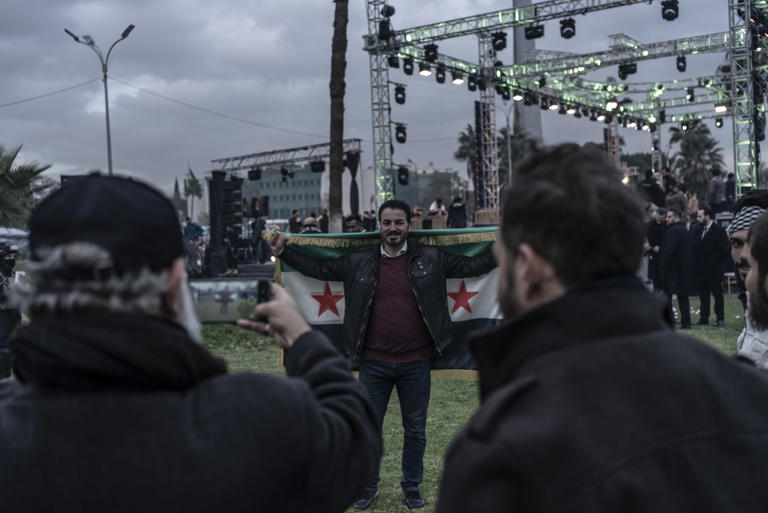
Branch 215
The documents digitized and reviewed by the Journal come from several units of the intelligence services that were housed in the Damascus security complex. They include Military Intelligence Branch 215, a unit whose officers tortured and executed prisoners as a part of the regime’s campaign to break the spirit of Syrians who opposed Assad, according to human rights groups, witnesses and former regime officials.
A range of ordinary Syrians were among those spied on, according to the documents and verified by interviews. One was a member of the well-known civil defense group the White Helmets from near the city of Homs, who ended up spending years in detention including in the brutal Saydnaya prison over his work with the rescue organization, which operated in areas controlled by rebels.
Another, a former municipal official from near the city of Hama, was reported to intelligence services simply for posting on social media about a joyous video call with relatives abroad—an act the regime typically saw as a sign of possible links to political opponents.
A range of files show the regime’s extensive spying on U.N. operations in the country, recording U.N. personnel’s movements and activities. One report from 2014 described a UNHCR delegation’s visit to a displacement shelter in Aleppo, listing the names and ID numbers of each member of the five-person group along with their hotel and details of their cars.
The delegation’s leader, Yoko Aksaka, a senior UNHCR official now on leave from the U.N., told the Journal that the file was proof of what she suspected was constant surveillance during her time in Syria.
“Whatever you say, even now what I’m saying, probably I should assume somebody hears,” she said.
Within the labyrinth of tunnels beneath Branch 215, intelligence officers crowded people they picked up into a prison with windowless concrete rooms, former detainees said. The prison included coffinlike cells for solitary confinement and other rooms strewn with chunks of human hair, blood stains and bullet casings when Journal reporters visited after the regime’s fall.
Ali Hamdan, a 47-year-old former military forensic official who is now cooperating with international war-crimes investigators, said in an interview with the Journal that his unit cataloged between three and 10 dead bodies each day from Branch 215 between 2012 and 2015.
Many had fractured skulls, burn marks and signs of electric shocks, he said. Forensic photographs of dead detainees, smuggled out of Syria by a whistleblower during the war, include many marked as coming from Branch 215.
Young rebel
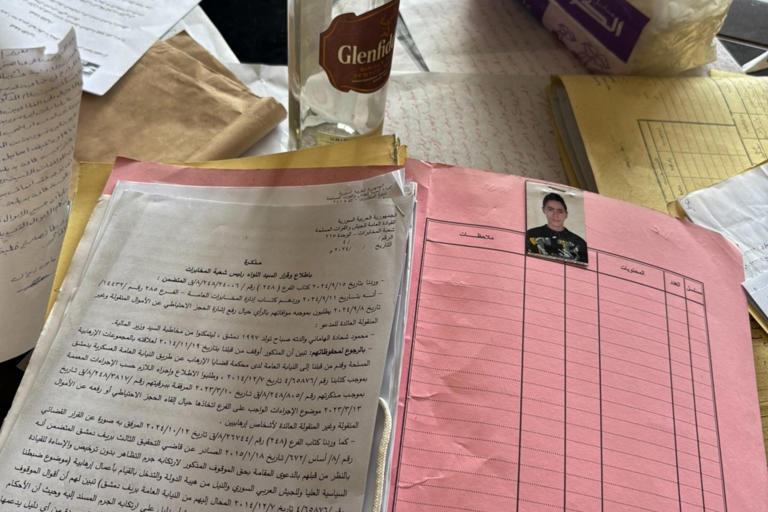
Another report uncovered by the Journal, on a cluttered desk near an empty bottle of Glenfiddich whisky, tells the story of a teenage boy in a patterned sweatshirt identified as Mahmoud Hammani.
The intelligence service said they detained him in 2014 at the age of 17 on suspicion of joining a rebel group. According to the file, he signed a written confession and said he had thrown rocks at security forces and helped observe regime military positions for the rebels. Afterward, he was released.
Syrian intelligence tracked the young man for much of the next decade, the report said.
Located by the Journal, Hammani today is a gaunt 28-year-old serving in the security forces of Syria’s new government. He pulls long shifts of guard duty in the city center and still lives with his family in a working class Damascus suburb.
After flicking through the digitized version of his file on a laptop, Hammani lit a cigarette and told the story behind the papers. At the time, his hometown was besieged by regime forces after a rebel group formed there. Security men seized him and threw him into the back of a truck and drove him to Branch 215.
Officers stripped him naked, strung him up by his wrists and shocked him with electricity, he said. They accused him of working with rebel commander Malath Salloum, the leader of a local branch of the mainstream Free Syrian Army, and demanded to know: “If you saw a Syrian soldier in front of you, would you kill him?”
In Hammani’s retelling, he relented after four days, applying his thumbprint to a written confession, which he wasn’t allowed to read. In the document, contained in a pink folder, Hammani confessed to aiding Salloum’s militia by observing regime positions. “The truth is that I am an opponent of the ruling regime,” said the document.
The confession was a lie, he said. He had no role in the armed rebellion.
Hammani said he was let go because his brother paid a bribe. The documents said his case was thrown out in court for lack of evidence.
Salloum left greater Damascus in 2016, agreeing to a truce with the government in exchange for safe passage to the rebel-held north. He returned this year, settling in his cousin’s stone house after nearly a decade in exile in the north and in Istanbul. He remembered being aware of Hammani as a teen who was too young to fight. “He was under 18. I didn’t give him a gun!”
After learning about the intelligence file from the Journal, he drove to Hammani’s house. “Why did you give my name to the intelligence?” said Salloum, who is now 45.
“They were beating me. I would have said anything to make it stop,” Hammani replied.
Salloum eyed the young man warily, got back in his car and drove away. As far as he was concerned, he said, Hammani was a collaborator.
Finding answers
Like many others, Kharouf, the imam in Damascus, had initially backed the movement against Assad when it erupted, family members said. But he pulled away when the uprising turned violent, preaching against armed attacks on the government and forbidding his three sons from joining militant groups.
In 2014 he signed an amnesty deal with the government, agreeing to give up opposition activity in exchange for a pardon. Everywhere he went, he carried his amnesty papers folded in his shirt pocket in case of trouble, his sons said.
After a year’s forced hiatus, Kharouf went back to work for Syria’s religious endowments ministry, giving approved sermons to his congregation. At night, he cheered his favorite soccer team, Real Madrid, with his sons in their one-story concrete house.
When the security men took him away in July 2020, the family went into shock. They phoned an uncle who had ties with the security services and had helped arrange Kharouf’s amnesty papers years earlier. But there was nothing he could do, he said.
Weeks went by and the family heard nothing. In September, his wife visited an office of the Syrian civil registry. The officials gave her a document, reviewed by the Journal, saying Kharouf had died in mid-August of 2020, but authorities refused to hand over the body.
An acquaintance who had been detained in the facility at the same time later told the family he saw the imam beaten to death with a chair. The Journal couldn’t independently verify the cause of the imam’s death.
One of the military intelligence documents, from July 2020, cited an interrogation of the imam’s cousin, Mahmoud Kharouf, who admitted to participating in the armed rebellion. He told interrogators that the imam had been working with rebels by giving religious approval for the rebels to carry out executions in the early days of the war.
“He was one of the supporters of the armed terrorist movement at the beginning of the current events in the country,” the document said of Kharouf.

The cousin, Mahmoud Kharouf, still lives nearby in a low-slung house on a muddy road, though the two families never speak.
In an interview, he denied that he ever mentioned the imam’s name, even during torture when he was forced to sign a confession saying he had fought with rebels. Crammed into the basement of Branch 215, the security men beat him on the legs with a green plastic pipe, he said. He was blindfolded and couldn’t even read what he was signing until he was shown the document by a judge in a later court hearing, he recalled. He still walks with a limp from the beating.
“The regime ruined my whole life,” he said, bursting into tears.
Abdu Kharouf’s immediate family said they believe the intelligence documents, having long suspected their cousin turned on them. Seeing the records brought some measure of closure, they said.
“Now we know,” said Mahrous Kharouf, the preacher’s eldest son. “We’ve been waiting for evidence. This person was the reason for his death.”
“I’m relieved,” Mahrous added, reflecting on his father’s life. “Now we know for sure he didn’t do anything wrong.”

You must be logged in to post a comment.