



 (Philip Thurston/E+/Getty Images)
A satellite has tracked a tsunami in greater detail than ever before, which could help improve models of these giant waves and allow for better prediction and warning systems.
Launched in 2022 by NASA and the French space agency Centre National d'Etudes Spatiales (CNES), the Surface Water and Ocean Topography (SWOT) satellite was designed to monitor the movement of the world's waters based on changes in surface height. But after a few years of capturing data on small currents, SWOT fluked a major event.
On 29 July 2025, a magnitude 8.8 earthquake struck the Kuril-Kamchatka subduction zone, off the southeastern coast of Russia. That sent a tsunami racing through the Pacific Ocean – just as SWOT happened to pass overhead.
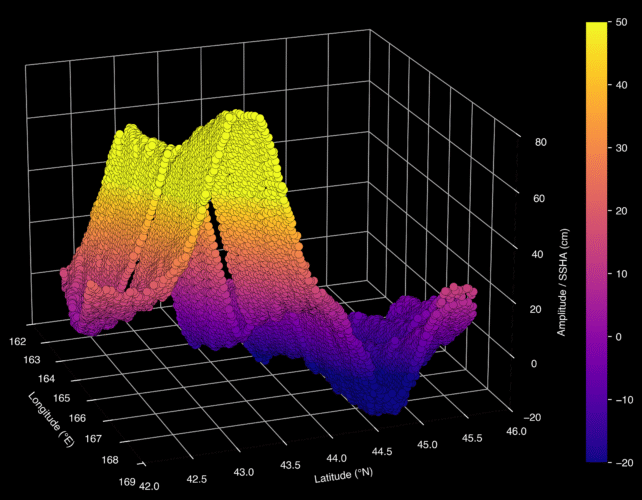 The leading edge of the tsunami visualized from sea surface height data from SWOT. (NASA/JPL-Caltech)
Using data from the satellite, as well as three buoys floating in the area as part of the Deep-ocean Assessment and Reporting of Tsunamis (DART) project, researchers were able to capture a pattern of propagation and scattering that was more complex than previously thought.
One major factor differed from existing models. It has long been assumed that big tsunamis are non-dispersive, meaning they mostly hold together as a single wave as they travel.
But the SWOT data suggest the tsunami broke up, forming a relatively large leading wave followed by smaller trailing waves.
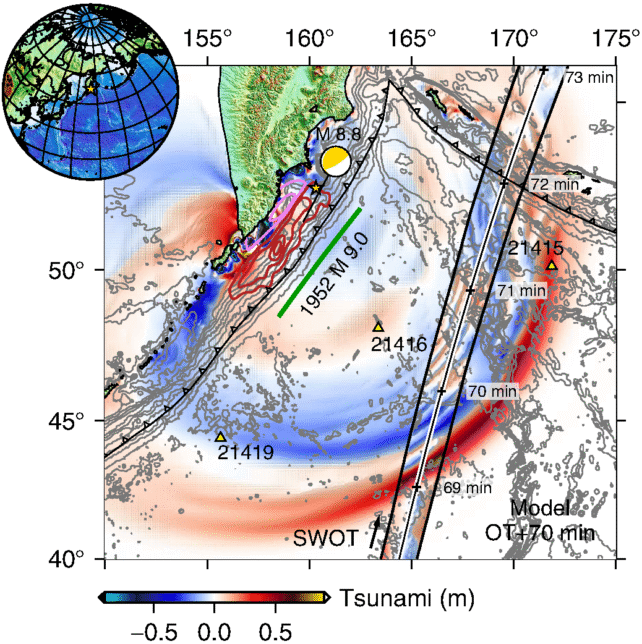 SWOT data on the tsunami. The star is the hypocenter of the event. The leading wave of the tsunami, shown in red, exceeded 45 centimeters (1.5 feet) in height. (Ruiz‐Angulo et al., TSR, 2025)
"I think of SWOT data as a new pair of glasses," says Angel Ruiz-Angulo, first author of the study and physical oceanographer at the University of Iceland. "Before, with DARTs we could only see the tsunami at specific points in the vastness of the ocean. There have been other satellites before, but they only see a thin line across a tsunami in the best-case scenario.
"Now, with SWOT, we can capture a swath up to about 120 kilometers [75 miles] wide, with unprecedented high-resolution data of the sea surface."

You must be logged in to post a comment.