

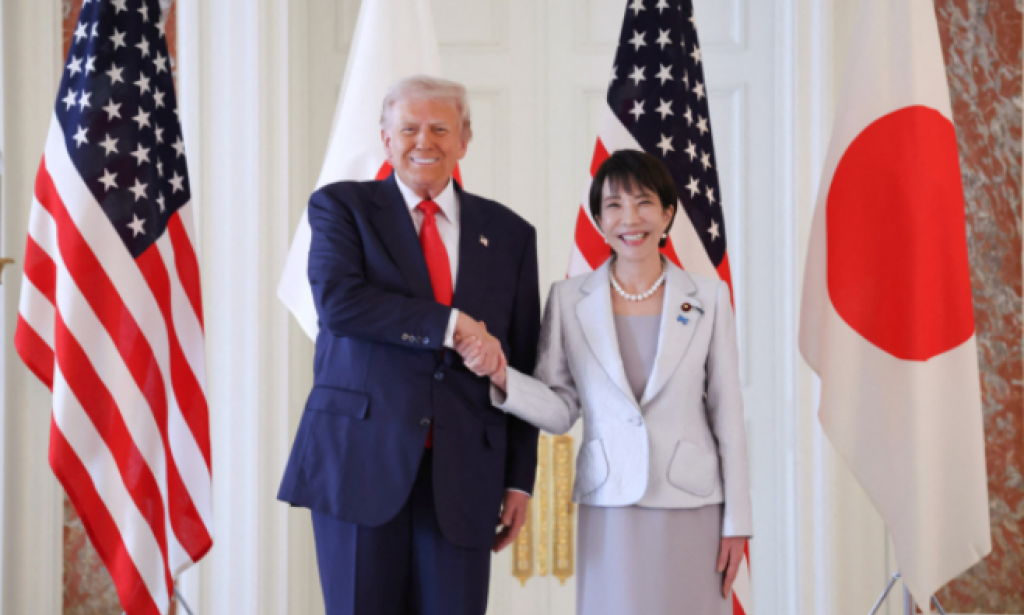

Epoch Times, November 25, 2025] (Epoch Times reporter Chen Ting) Japanese Prime Minister Sanae Takaichi held a telephone conversation with US President Donald Trump on Tuesday (November 25), reaffirming close cooperation between Japan and the US and exchanging views on the Indo-Pacific situation and US-China relations.
This was a phone call between the leaders of Japan and the US shortly after Trump's call with Chinese Communist Party leader Xi Jinping, and Takaichi's first interaction with Trump since her remarks regarding "Taiwan issues" embroiled her in a diplomatic dispute with Beijing. Observers believe this highlights the immediate strengthening of the US-Japan alliance amid escalating tensions in the Indo-Pacific region.
Takaichi stated that the call was initiated by Trump and lasted approximately 20 minutes. Trump briefly explained to her the content of his call with Xi Jinping the previous evening, concerning recent developments in US-China relations, but Takaichi did not disclose further details or indicate whether her remarks regarding Taiwan earlier this month were discussed.
Trump Emphasizes Kao Chia is a Close Friend, Always Ready to Call
Besides strengthening the Japan-US alliance and discussing the situation in the Indo-Pacific region, the two sides also discussed a wide range of other issues. Kao Chia expressed Japan's high appreciation for the US efforts to promote peace in Ukraine and briefed Trump on the situation at the G20 summit in South Africa, which Trump did not attend.
Trump stated in the phone call that Kao Chia is an "extremely close friend" to him and that he is always happy to answer her calls.
On November 7, during a parliamentary inquiry, Sanae Takachi stated that if the CCP launches a military attack on Taiwan, it could constitute a "life-or-death crisis" for Japan. This statement was interpreted by outsiders as the Japanese government potentially authorizing the Self-Defense Forces to provide support within the Japan-US alliance framework should Taiwan be under blockade or coercion.
Kao Chia's remarks touched a nerve in Beijing, triggering a strong reaction. Xue Jian, the Chinese Consul General in Osaka, commented on Kao Chia's "if something happens to Taiwan" remarks on the social media platform X, stating, "We can only cut off the dirty head that has trespassed without hesitation." This statement caused a huge uproar in Japan. The Japanese Foreign Ministry summoned the Chinese ambassador overnight to protest.
This series of events rapidly deteriorated Sino-Japanese relations, leading Beijing to announce a ban on Japanese seafood imports and launch a boycott of Japanese tourism.
However, Trump has yet to publicly state his position on Kaohsiung's remarks regarding "Taiwan's future."
Japanese Chief Cabinet Secretary: Stable US-China relations are important to the world.
The day before Kaohsiung's meeting with Trump, Xi Jinping also called Trump. Xinhua News Agency, the official media outlet of the Chinese Communist Party, reported that Xi Jinping emphasized during the call that "Taiwan's return to China" is one of the core aspects of Beijing's vision for the world order.
However, in his public statement after the call, Trump only mentioned progress on US-China trade issues and did not reveal whether the Taiwan issue was discussed.
In response to this news, Premier Cho Jung-tai of the Republic of China (Taiwan) stated clearly on Tuesday: "The Republic of China (Taiwan) is a completely sovereign and independent country," and for the 23 million people of Taiwan, "returning" to China is not an option.
Japanese Chief Cabinet Secretary Minoru Kihara stated at a regular press briefing on Tuesday that the stability of US-China relations is "extremely important" for Japan and the international community. However, he declined to comment on Beijing's statement regarding the Trump-Xi meeting.
Kihara emphasized that Japan will continue to urge China to "fulfill its responsibilities commensurate with its role," based on its relationship of trust with the United States.
Japan Sends Letter to UN Secretary-General Refuting Chinese Accusations
Japan's Permanent Representative to the United Nations, Kazuyuki Yamazaki, sent a letter on Monday to UN Secretary-General António Guterres refuting accusations made by China.
In the letter, Yamazaki emphasized that Japan's basic policy is "exclusively defensive." He pointed out that China's claim that "Japan will exercise its right to self-defense even without being attacked" is erroneous.
Yamazaki stated that Japan's position on Taiwan has remained unchanged since the normalization of diplomatic relations between the two countries in 1972, adding that Tokyo hopes to resolve the Taiwan issue peacefully through dialogue.
Yamazaki pointed out that China's people-to-people exchanges and economic ties with Japan have cooled down, including seafood trade. He stated that Japan will handle related issues calmly and through dialogue.

You must be logged in to post a comment.