

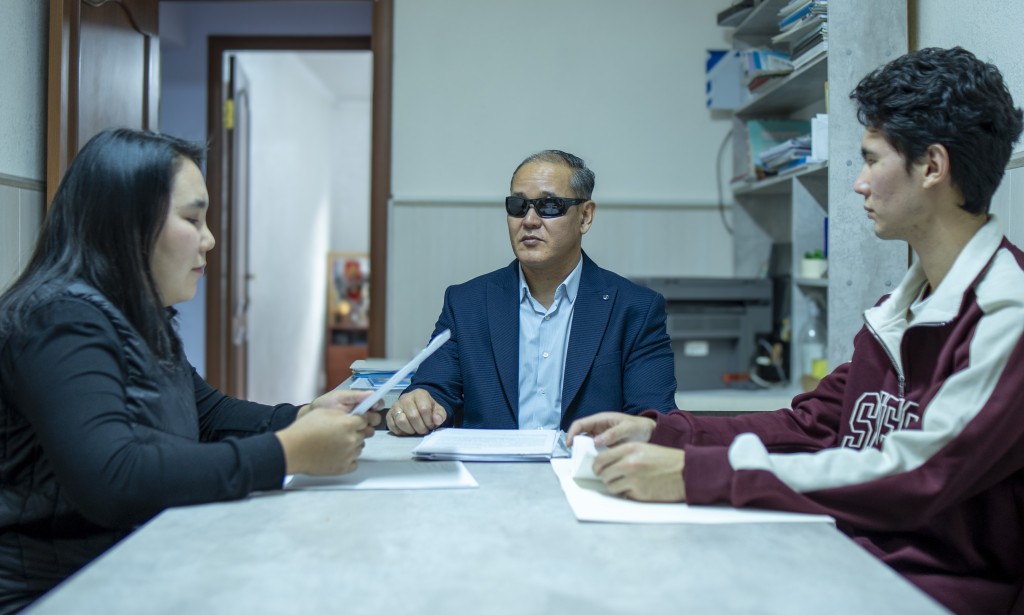

Tolkunbek Isakov, Deputy Chair of the Council for persons with disabilities and president of the PF “Legal Aid”, is a person who has been working with people with disabilities for many years. From October through May, he was a part of an UNDP project that consisted of several stages, including educating people with disabilities, involving them in discussing pressing issues, and changing legislation.
Tolkunbek Isakov, Deputy chair of the Council for persons with disabilities and president of the PF “Legal assistance”, is a person who has been working with people with disabilities for many years.
From October through May, he was a part of an UNDP project that consisted of several stages, including educating people with disabilities, involving them in discussing pressing issues, and changing legislation.
The work was carried out in the logic of the implementation of the UN Convention on the Rights of Persons with Disabilities and the Law of the Kyrgyz Republic "On the Rights and Guarantees of Persons with Disabilities", which requires the state to take a systematic approach to protecting the rights, accessibility, and participation of people with disabilities.
Training that provided applied knowledge for the first time
About 300 people with disabilities attended training courses, consultations, and discussions. Employees of state and municipal bodies also joined those activities: from about 15 agencies in total, about 40 participants from non-governmental organizations. The geography was quite wide: five organizations represented Chui oblast, four from Issyk-Kul oblast, three from Osh oblast, and two from Batken, Jalal-Abad, and Talas oblast. Many of them came for the first time, although the country regularly hosts seminars on the rights of people with disabilities.
But the main difference between these training courses is their relevance. People came to get something they had not received before applied information that really helps them realize their rights in accordance with the principles of the CRPD and national law.
But the main difference between these training courses is their relevance, which is probably why they gathered a large number of participants. People came to get something that was not received before — applied information.
“The same organizations have been coming to us for years," says Isakov. — The format was predictable: they provided some suggestions, then they left and everything remained unchanged. Or we listened to lectures on topics that we already knew.” This time, the set of topics was broader and more specific: international and national law, strategic planning, monitoring, fundraising, climate risks, and emergencies.
Each topic was designed as a separate training, and for the first time, the participants took out really useful information.
"One participant came up after the training and said that he would immediately pack an emergency suitcase at home. Before, people didn't even know about it. Now they have specific instructions on how to protect themselves and their family members in an emergency,” says Isakov.
The results were recorded using a pre-test and a post-test. The level of training participants’ knowledge steadily grew: both in terms of rights, security, and financial stability.
“Participants from the Issyk-Kul region were interested in a lecture about water batteries — granules that retain moisture during drought. People plan to apply the technology immediately upon returning home. There were other discoveries, some parents of children with disabilities first heard that the employer is obliged to release them at a certain time and several people used this right the next day: there were violations, and the training gave them tools,” says Isakov.
He notes that there was also an unexpected audience: civil servants who came as representatives of departments, and in the process of discussion, suddenly talked about their relatives with disabilities:
"Sometimes at the trainings it turned out that the officials have a person with a disability in their families, and at the same time they did not know what benefits and guarantees they were entitled to by law," says Isakov.
From open conversation to research: what problems did the participants name themselves
If the training courses provided tools, the round tables gave people the opportunity to prove themselves even in the legislative sphere.
In fact, this is how the requirement of the UN Convention on the Rights of Persons with Disabilities is implemented to involve people with disabilities in the development of solutions that concern them.
At the first-round table, participants listed specific problems: the lack of mechanisms for evacuating people with disabilities, difficulties in accessing medical care, cases of domestic violence, and discrepancies between laws and how they are applied in districts and villages.
It wasn't a set of complaints. It was a set of facts that required analysis.
And on the second-round table, everyone moved from conversation to research and amendments to the laws.
After the first discussion, the experts identified three laws in which the gap between the norm and practice was most noticeable: the law on civil protection, on health care, and on domestic violence.
It was decided to conduct a large-scale study, and about 700 people were interviewed — people with disabilities, civil servants, and employees of local self-government. The study described situations that are not indicated in official documents: for example, how a person in a wheelchair leaves the building during an earthquake if the evacuation plan simply does not consider this.
The results turned out to be so substantive that the Ministry of Emergency Situations, for the first time, agreed to create an interagency working group, open internal instructions, and start preparing amendments to the law on civil protection.
The work on the change project is already underway, also within the framework of the state programme “Accessible Country”, which provides the removal of barriers and the adaptation of services for persons with disabilities
The Council for People with Disabilities changed the format of work after 5 years, when no updates were made
The project also changed the work of the Council itself, where Isakov works. The Regulation on the Council has not been updated since 2020. During this time, state structures changed their names and powers, but the key problem was not even that.
“Our decisions were more advisory in nature. They were either not taken into account or taken into account, but when they reached the districts and the villages were distorted or not implemented,” says Isakov.
Now a new draft provision has been prepared, in which the decisions of the Council become binding, representatives of the regions are included in the composition for the first time (previously only Bishkek and Chui participated), for remote locations, meetings will be available online. The Council plans to be empowered to monitor all bills affecting the rights of people with disabilities before submitting them to parliament.
The document passed public hearings and is in the process of being signed by the Chairman of the Cabinet of Ministers.
UNDP support: experts who stayed in touch even at night
Isakov emphasizes: the UNDP team did not conduct training directly, but provided methodological, expert, and consulting support at all stages.
“If necessary, we could contact them even at night. They helped, guided, and monitored compliance with the terms of reference; it was very comfortable to work,” he says.
Isakov is not prone to emotions, but when asked about the main result, he answers: there is knowledge that people immediately apply, there are changes that can go to the Jogorku Kenesh and change laws, the Council is close to getting tools to monitor the implementation of decisions, and state bodies have begun to review their own procedures.
“We used to talk about the problems as someone's private issue; we would gather, discuss them, feel sympathy, and then go our separate ways,” says Isakov. In this project, we talked about them as systemic issues, and that changes everything that will happen next.”

You must be logged in to post a comment.