


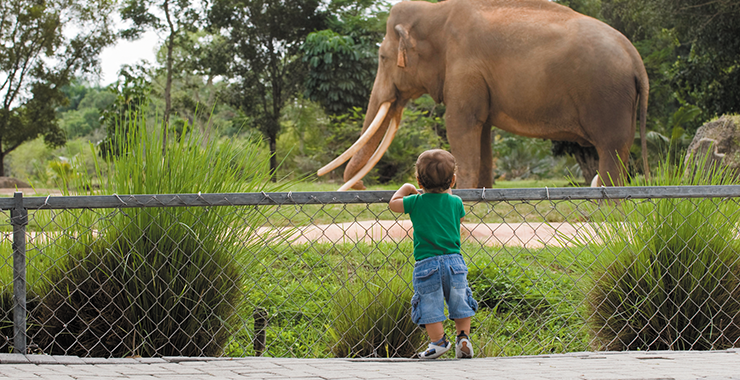
The elephants at ZooTampa do more than just eat, sleep and entertain visitors—they also participate in psychological research. In one recent study in which the elephants solved puzzles to retrieve food, for example, Lauren Highfill, PhD, a professor of psychology and animal studies at Eckerd College in St. Petersburg, Florida, found that the zoo’s calves could solve more complex problems than its adult elephants, perhaps because the younger elephants were more behaviorally flexible (International Journal of Comparative Psychology, Vol. 31, 2018). Now, Highfill is testing the elephants’ cooperation skills using a food-filled sled attached to a rope, which pairs of elephants must pull simultaneously to retrieve their reward.
Psychologists like Highfill, who also studies personality in dolphins, lemurs and bush babies, conduct research that can lead to a deeper scientific understanding of the behavior and cognition of nonhuman animals. But such studies also provide several other benefits, including meaningful enrichment activities for animals and insights into ways zoos and aquariums can better meet the behavioral needs of their charges. And research in these settings serves another important purpose: It can help the public engage with science and an institution’s broader conservation goals, which may include protecting endangered species or reducing waste and pollution.
“Where zoos and aquariums add value is by connecting people with animals,” says Christopher Kuhar, PhD, executive director at Cleveland Metroparks Zoo and chair of the board of directors of the Association of Zoos and Aquariums (AZA). “That’s sometimes done with knowledge, but often with emotion—and psychologists are well positioned to study emotion, engagement and behavior change to understand how zoos can effectively make that connection.”
These benefits are powering a larger trend toward zoos and aquariums increasingly embracing research, including by psychologists, as a key part of their public service missions. Around 25 institutions—about 10% of all facilities accredited by the AZA—now employ psychologists in full-time positions overseeing research, animal welfare and the visitor experience, according to an analysis by psychologist Terry Maple, PhD, director of animal wellness at the Jacksonville Zoo and professor emeritus at the Georgia Institute of Technology, and Meredith Bashaw, PhD, professor of psychology at Franklin & Marshall College in Lancaster, Pennsylvania (Kaufman, A.B., et al., “Scientific Foundations of Zoos and Aquariums,” 2019). Other zoos and aquariums partner with psychologists based at nearby universities who study animal behavior.
Understanding animal needs
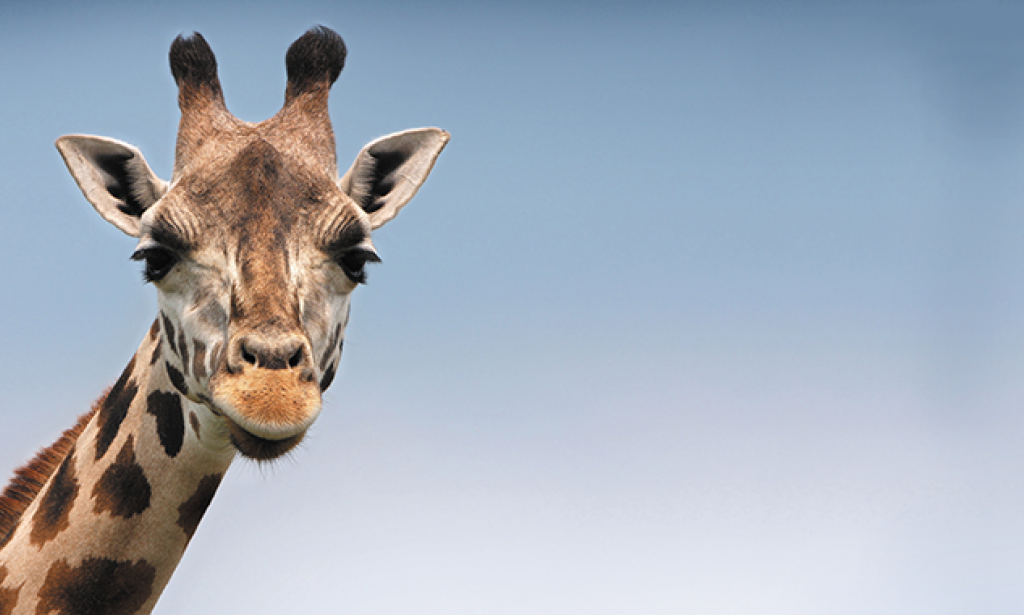
Thanks to the support of local communities and conservation-focused guests and donors, zoos and aquariums can afford to house animals that require significant care and resources, making them key partners for psychologists who conduct comparative and cognitive research. For researchers who study non-native species, such as elephants or giraffes in the United States, partnering with zoos is often the only feasible way to gain access to these animals.
Such collaboration also allows psychologists to seamlessly conduct comparative research across several species at one time. In Cleveland, for instance, psychologists are studying bears, giraffes and several primate species to better understand their personalities and cognitive capacities. In San Francisco, researchers are developing a puzzle to provide stimulation for the zoo’s male black rhinoceroses.
“Zoo-university partnerships are a win for students and researchers because they can access animals we could never afford to support, a win for zoos because the research contributes to animal wellness, and a win for animals because these partnerships ultimately spur conservation efforts in the wild,” says George Rainbolt, PhD, dean of the University of North Florida’s College of Arts & Sciences, which maintains a close partnership with the nearby Jacksonville Zoo.
Another upside is that these facilities provide an ideal setting for undergraduate and graduate students to learn techniques and technologies for observational data collection, as well as how to interact with zoo staff and the public.
But psychologists say one of the most rewarding aspects of conducting research at zoos and aquariums is that their work contributes to animal wellness—a research and practice domain Maple helped launch that integrates insights on human wellness with animal care. For one, the research itself is a form of cognitive enrichment for zoo animals that may be physically well accommodated but mentally understimulated.
“In the wild, these animals would be constantly problem-solving—hunting or foraging for their food or avoiding predators,” says Highfill. “When we conduct cognitive research, it presents them with challenges they need to think through, which can make their lives more dynamic.”
In addition, such research sheds light on the needs of captive animals and points to ways zoos can improve their wellness protocols. At the Tennessee Aquarium, for instance, Preston Foerder, PhD, an assistant professor of psychology at the University of Tennessee at Chattanooga, is studying a group of nine male juvenile alligators—a dynamic unlikely to occur in the wild. But the insights he gains from his research—for instance, how removing and returning an alligator to an exhibit alters the group’s social organization—can help the aquarium provide a better habitat for the animals.
Supporting public learning
Another key demographic stands to benefit from the work of psychologists in zoos and aquariums: the visitors. Not only can a trip to the zoo have therapeutic effects for visitors, including reducing stress (Sahrmann, J.M., et al., Zoo Biology, Vol. 35, No. 1, 2016), but these institutions also educate the public about scientific research and conservation.
“Sometimes people forget that science doesn’t only happen in test tubes,” says Heidi Harley, PhD, professor of psychology and director of the environmental studies program at New College of Florida in Sarasota. “It’s good for the public to see psychologists doing live research so they know there are other ways of thinking about science.”
Harley collected the data for her studies of dolphin cognition, echolocation and sensory integration in front of a public audience at Walt Disney World’s aquatic attraction, The Seas with Nemo and Friends. She found that visitors spent more than four times longer at an animal exhibit when cognitive research was underway (International Journal of Comparative Psychology, Vol. 23, No. 3, 2010). Another survey of more than 7,000 zoo visitors showed that connecting with animals was linked to increased cognitive and emotional responses to the issue of climate change (Clayton, S., et al., Environmental Education Research, Vol. 20, No. 4, 2014).
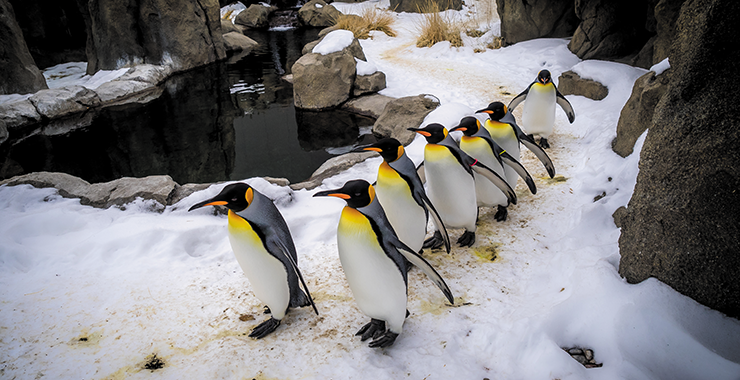
Those insights have been key for psychologists who hope to design zoo attractions that both engage audiences and promote conservation behaviors. At ZooTampa, Highfill is testing the effect of “up-close encounters” between visitors and animals on the zoo’s main conservation goal: reducing the use of single-use plastic. Her team is surveying zoo visitors before, immediately after and one month following a penguin encounter in which visitors learn about plastic pollution and its effects on marine animals. Highfill is testing whether the exhibit affects visitors’ use of disposable straws, whether they bring reusable bags to the grocery store or otherwise reduce their plastic use.
“We’re hoping the experience helps visitors grasp how plastic waste can impact these animals so they might be more motivated to refuse a straw than they were before,” Highfill says.
Another collaborative research effort funded by the National Science Foundation and co-led by conservation psychologist John Fraser, PhD, past president of APA’s Div. 34 (Society for Environmental, Population and Conservation Psychology) and CEO of the think tank Knology, is assessing public perceptions of zoos and aquariums in partnership with more than half of the 238 institutions accredited by the AZA. The researchers are also assessing how these institutions can better meet their conservation goals.
With so many institutions using research insights to enhance conservation efforts, animal care and the visitor experience, roles for psychologists are now extending beyond zoo-university partnerships. Across the United States, in-house positions overseeing research, education, conservation and animal wellness are cropping up—and many of them are being filled by psychologists.
“More and more zoos and aquariums now employ people to oversee research, animal welfare, training and enrichment, and psychologists are a great fit for this type of work,” says psychologist Jackie Ogden, PhD, former vice president of animals, science and environment for Walt Disney Parks and Resorts and former chair of the board of directors of the AZA.
In her role at Disney, Ogden drew on her background in both animal behavior and industrial/organizational psychology to oversee care for 5,000 animals and lead a team of more than 650 employees. Throughout her tenure, she worked to build a broader culture of conservation among Disney staff, volunteers and visitors, including by encouraging employees to participate directly in conservation efforts and green behaviors.
For psychologists interested in working at a zoo or aquarium, she recommends joining the AZA, which offers student memberships and an annual conference. University-based researchers hoping to partner with nearby zoos and aquariums can also use the AZA to make connections and to discover what zoo administrators seek to gain from research collaborations.
“Most zoos are working overtime. Even if they’re excited about research, it’s rarely their top priority,” says Highfill. “That’s why it’s important to approach them with projects that will be mutually beneficial.”
She recommends researchers start by asking zoos what questions they hope to answer and then design their research accordingly. For example, shortly after Foerder moved to Chattanooga, he learned that the Tennessee Aquarium wanted to create a public-facing demonstration of crow cognition. He designed an experiment to test the ability of American crows to solve problems using tools. The aquarium got their demonstration and Foerder collected data on an understudied crow species. That initial collaboration also launched an ongoing relationship between Foerder and the aquarium—and he now has more freedom to design studies based on his evolving research interests.
Public partnerships
Looking forward, zoo scientists hope to see increased collaboration between researchers at various institutions, which could lead to larger sample sizes and better standardization of research protocols.
Ogden also expects to see enhancements in the ways visitors experience and understand animals, including innovative applications of technology—for instance, virtual or augmented reality—to help people safely interact with and experience exotic species. For example, a zoo might offer visitors the chance to join a virtual gorilla trek, where they can walk and sit among a family of gorillas in their natural habitat, after observing the species at the zoo.
At the same time, psychologists are optimistic about the role they can play in shifting the priorities of zoos and aquariums to mitigate and even reverse the damage caused by humans in a rapidly changing world.
“Climate change and habitat destruction aren’t environmental problems—they’re human behavior problems,” Fraser says. “And if we want to change human behavior, we need psychologists on the front lines.”

You must be logged in to post a comment.