

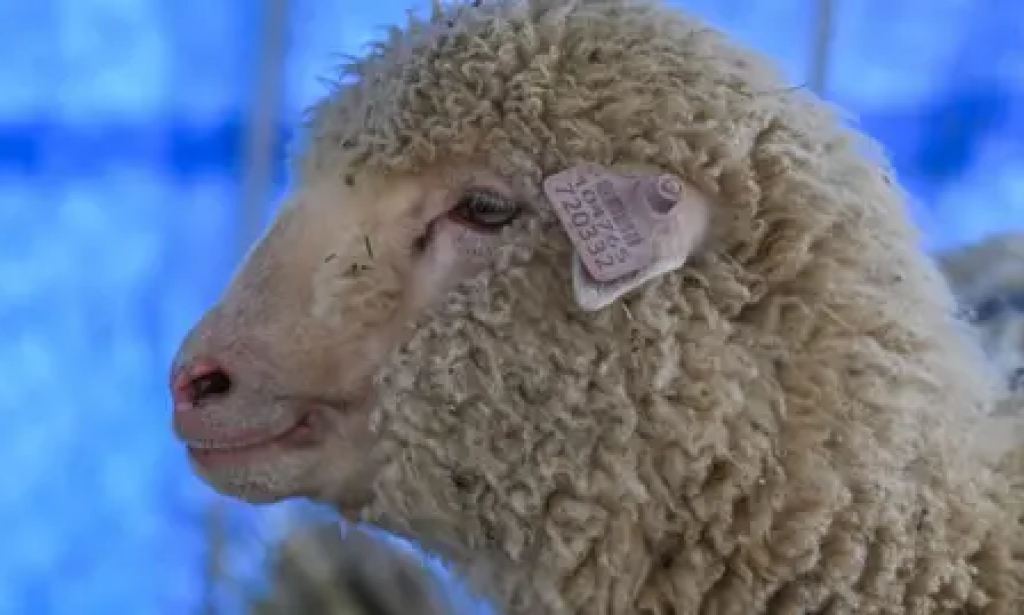

 India's first gene-edited sheep recently turned a year old and researchers who developed it say it's doing well.
Born on 16 December last year in Indian-administered Kashmir, the sheep has been named Tarmeem – the Arabic word for modification or editing.
Tarmeem is housed in a private enclosure at the Sher-e-Kashmir Agricultural University in the region's main city Srinagar along with its non-edited twin sister.
Researchers at the university told the BBC that they used CRISPR technology - a biological system for altering DNA – to develop it.
Basically what it allows scientists to do is use it like a pair of scissors to chop off bits of a gene that cause weaknesses or diseases.
"We extracted a number of embryos from pregnant sheep and edited a specific gene - known as the myostatin gene - which negatively affects muscle growth," researcher Dr Suhail Magray told the BBC.
The embryos or fertilised eggs were kept in controlled laboratory conditions for two-three days after which they were transferred to a female sheep - or the foster recipient.
"And then nature took over - 150 days later, lambs were born," he said. "Our aim was to increase the muscle mass in sheep and by knocking out the myostatin gene, we successfully managed to do that," he added.
After Tarmeem turned one earlier this month, Prof Riaz Shah, the dean of faculty of veterinary sciences and principal investigator on the project, gave the BBC a status update.
"It's growing well, showing normal physiological, biochemical and physical parameters," he said. "Tarmeem's muscle growth has expectedly shown significant increase - about 10% - in comparison to its non-edited twin. I think it is likely to increase further with age."
Experimentation is going on to evaluate its health and survival and the sheep is kept in a secure environment under strict surveillance, Prof Shah said, adding that they have submitted a research project to the government for funding support. Sheep have been genetically modified and gene-edited for decades, mainly for research and medical purposes. Early experiments, like the 1990s UK sheep "Tracy," produced therapeutic proteins in milk. Today, CRISPR is used to study traits such as muscle growth, disease resistance, and fertility.
The eight-member team that worked on developing India's first gene-edited sheep had been at it for seven years.
"There were a few false starts. We tried multiple strategies, and the breakthrough finally came in December 2024. We did seven IVF procedures, we had five live births and two abortions. Gene-editing was successful in only one," Prof Shah said.
"We started from zero. But we have now standardised the practice and I think the success rate would be high in future."
The scientists are excited by the experiment's success, saying it could help secure sustainable mutton production in the Kashmir Valley, which consumes around 60,000 tonnes annually but produces only half. That, of course, depends on government approval for farming or consumption.
"Land is getting squeezed, water is getting depleted, population is growing but space available for growing food is shrinking," says Prof Nazir Ahmad Ganai, the university's vice-chancellor.
"Our state is deficit in mutton, but gene-editing can raise a sheep's body weight by 30%. This would be very useful for sustainable food production as it would mean fewer animals can provide more meat," he says.
If the government grants permission for replicating this technology in large flocks, Prof Ganai says, they can use it to farm sheep and, later, other animals.
"Many institutions in India are working on pigs, goats and poultry. The future is bright," he adds.
Discovered in 2012, gene-editing technology earned its co-inventors Emmanuelle Charpentier and Jennifer Doudna a 2020 Nobel Prize and has revolutionised medical research. But it remains controversial, with ethical debates fuelled by its resemblance to genetic modification (GM).
Scientists emphasise that gene editing and GM are fundamentally different: gene editing tweaks existing genes within a plant, animal, or human, while GM involves introducing foreign genes.
Countries like Argentina, Australia, Brazil, Colombia and Japan treat some gene-edited fish, cattle and pigs as natural, allowing them for consumption.
The US and China use the technology to create more productive, disease-resistant crops and animals; the US FDA recently approved a genetically enhanced pig, and the UK will allow gene-edited foods next year.

You must be logged in to post a comment.