

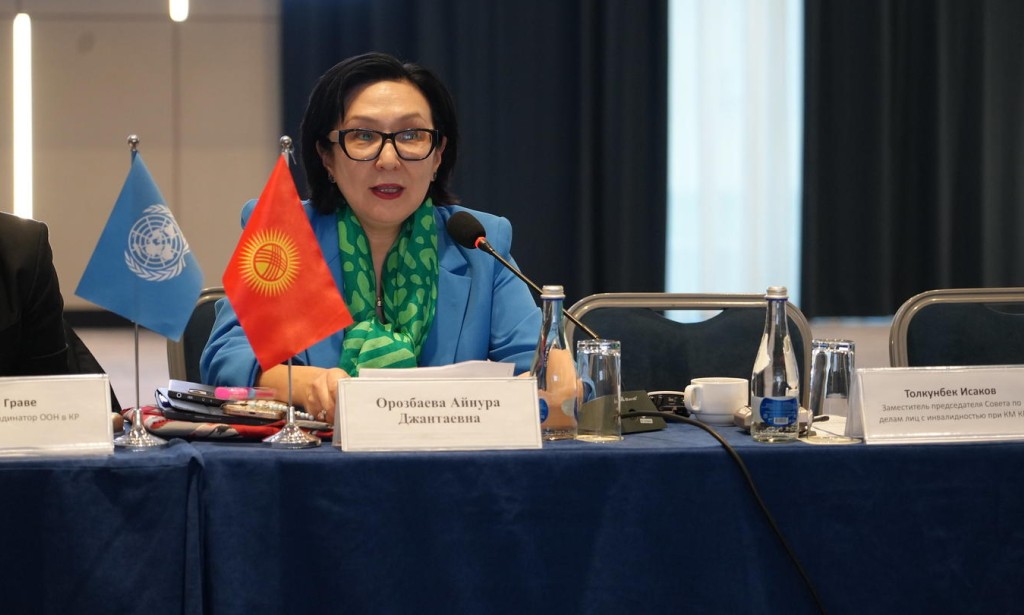

Bishkek, 15 December 2025 — The Ministry of Labour, Social Welfare and Migration of the Kyrgyz Republic, together with the Council for Persons with Disabilities under the Cabinet of Ministers and the United Nations system in Kyrgyzstan, convened the final meeting of the Council to present the results of the UN Global Disability Fund (UNGDF) project Promoting the Rights of Persons with Disabilities in Kyrgyzstan, implemented during 2024–2025. The meeting reviewed concrete progress in strengthening national systems, legislation, and service delivery to advance the rights and inclusion of persons with disabilities.
The event brought together senior government officials, heads of UN agencies, organizations of persons with disabilities, and civil society partners to assess results achieved, identify remaining implementation gaps, and agree on next steps to sustain disability-inclusive development within national policies and programmes.
UNDP supports to the Government of the Kyrgyz Republic in implementing the state programme “Accessible country” and the UN Convention on the Rights of Persons with Disabilities (CRPD) both contributing to the advancement of the 2030 Agenda for Sustainable Development.
The project has been implemented by UNDP, UNICEF and UNFPA under coordination of the UN Office of the Resident Coordinator.
Government representatives, including Minister of Labour, Social Welfare and Migration Kanat Sagynbaev and Deputy Chair of the Council for Persons with Disabilities Tolkunbek Isakov, outlined national priorities focused on accessibility, service quality, and implementation of disability-related legislation.
Over the two-year period, the joint project supported the integration of disability inclusion, gender equality, and climate considerations into national policy frameworks, strengthened the capacity of the Council for Persons with Disabilities and organizations of persons with disabilities, and contributed to progress in aligning national legislation with the CRPD.
UNDP’s contribution focused on enabling persons with disabilities to influence policy and institutional practice through applied knowledge, structured dialogue, and evidence-based analysis. With UNDP’s methodological and expert support, targeted trainings, consultations, and research helped translate legal standards into practical tools and informed policy discussions with government institutions. This work contributed to the identification of systemic barriers in civil protection, health care, and prevention of domestic violence, and supported interagency processes to prepare legislative amendments, including in civil protection.
Alexandra Solovieva, UNDP Resident Representative: “This project demonstrates how effective change happens when the disability community and government institutions work together around clear national priorities. UNDP supported practical tools, data, and dialogue that enabled people with disabilities to engage directly in policy discussions, while helping state institutions strengthen implementation of existing laws and programmes. This approach ensures that disability inclusion is embedded in national systems and aligned with the Government’s reform agenda, rather than treated as a standalone issue.”
Participatory discussions and research identified systemic barriers in civil protection, health care, and the prevention of domestic violence, leading to a large-scale study. The evidence generated informed the creation of an interagency working group under the Ministry of Emergency Situations and supported preparations for legislative amendments on civil protection in line with the “Accessible Country” programme.
The project also supported institutional reform of the Council for Persons with Disabilities. A revised draft regulation proposes strengthening the Council’s mandate, expanding regional representation, enabling remote participation, and formalizing its role in reviewing draft legislation affecting the rights of persons with disabilities.
Tolkunbek Isakov, Deputy Chair of the Council for Persons with Disabilities, is expected to underline that the project enabled persons with disabilities to shift from raising concerns to developing concrete proposals, backed by data and legal analysis, and that the strengthened role of the Council creates new mechanisms for monitoring how decisions are implemented at national and local levels.
An independent evaluation confirmed that the project contributed to improved institutional capacity, stronger coordination between government and civil society, and more informed policy decision-making grounded in evidence and participation.
The project was jointly implemented by UNDP, UNICEF, and UNFPA under the overall coordination of the UN Resident Coordinator in Kyrgyzstan, with financial support from the UN Global Disability Fund.

You must be logged in to post a comment.