

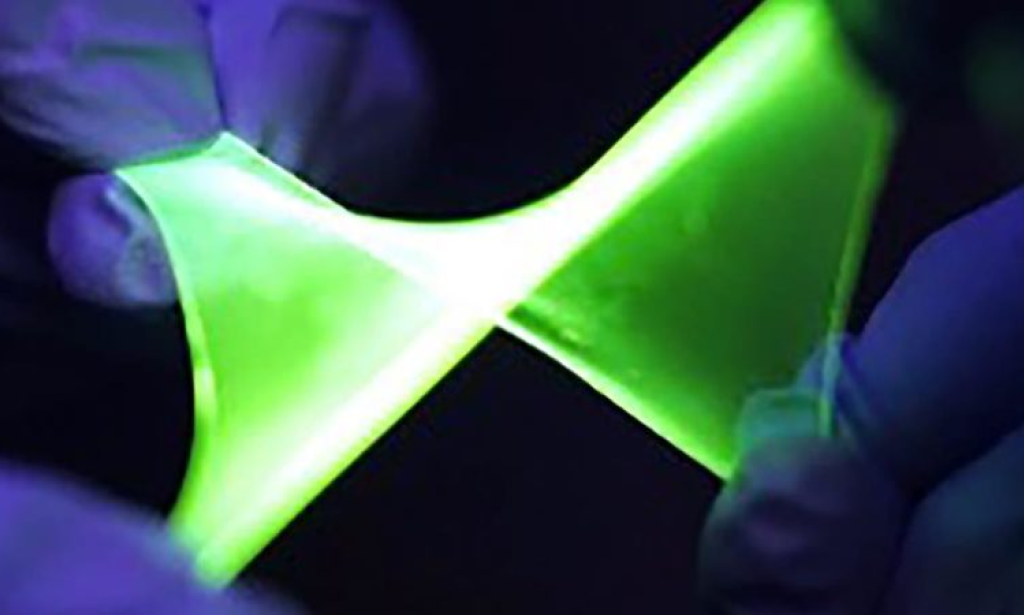

Flexible OLED wearable display devices used for real-time healthcare monitoring or communication have long faced the challenge of reduced light emission durability after repeated mechanical bending. Engineers have been searching for OLED materials that can maintain bright and stable light while being stretched.
Why do flexible OLEDs gradually lose brightness during the stretching process?
Organic light-emitting diodes (OLEDs) are semiconductor electronic devices that emit light. The principle of light emission is that positive and negative charges pass through multiple layers of organic materials, and electrons and holes combine to form excitons, releasing energy and emitting light. The specific color depends on the chemical composition of the organic layers.
Flexible OLEDs attach these materials to a bendable substrate. This technology became active in the market after Samsung launched the world's first curved screen phone with a flexible OLED in the 2010s. However, over time, researchers noticed that the brightness of flexible OLEDs would decrease after repeated bending, which is related to the gradual damage to the electrodes and organic materials.
To make conductive materials flexible, they usually need to be doped with an insulating but stretchable polymer, which hinders charge transport and reduces luminous efficiency. In addition, the longer the OLED is bent and stretched, the more brittle the most commonly used material in the electrodes becomes and the easier it is to break.
To overcome these problems, the research team redesigned the light-emitting layer with a special organic material, ExciPh (exciplex-assisted phosphorescent), which makes it easier for charges to combine and form excitons to increase light output. More than 57% of the excitons generated in the ExciPh layer are converted into light; in contrast, the common polymer layers in current OLEDs only convert 12-22% of excitons into visible light emission.
To further enhance the material's flexibility, researchers embedded the ExciPh layer into a thermoplastic polyurethane elastic substrate and combined it with the highly conductive two-dimensional nanomaterial MXene and silver nanowires to redesign the transparent stretchable electrode to improve charge transport. This helps the charge move more effectively to the light-emitting polymer layer before forming excitons, ultimately allowing the OLED display to maintain brightness even after repeated stretching or bending.
According to the team's tests, the new OLED has better brightness and energy efficiency than the previous design. When stretched to the maximum strain of 60%, the performance drops by only 10.6%, and the external quantum efficiency of converting electricity into light also reaches a record high of 17%.
Scalable OLED products that can maintain brightness over a long period of time have broad application potential, including industrial operations, robotics, wearable devices, and communications. In particular, they are used in health monitoring devices that directly display body temperature, blood flow, or skin pressure. In the future, displays used for diagnosis and treatment may be directly embedded in clothing or "electronic skin."

You must be logged in to post a comment.