


The Age of Disclosure director Dan Farah doesn’t just contend that aliens are real. His film makes a fascinating case that the U.S. government has been covering them up for eight decades, in hopes of reverse-engineering their technology for the betterment of humanity — or at least the U.S. government.
Raise a theory about what might have really happened outside Roswell, New Mexico, in 1947, and Farah is happy to tell you.“A couple of the intelligence officials I interviewed went on the record talking about the details of the crash that happened at Roswell, and how the technology — the recovered elements of the craft and the non-human bodies that were found at the crash site — were brought to Wright-Patterson Air Force Base in Ohio, where at the time, the Army Air Corps had their their best reverse engineers,” says Farah, whose film has broken Prime Video records and is taken seriously enough in political circles to have screened last month for members of Congress.
Dan Farah has a calm, unflappable affect, perhaps because he is well aware of the skepticism that comes with any serious investigation of UAPs — aka Unidentified Anomalous Phenomena, and previously best known as UFOs.
He says he approached The Age of Disclosure as cautiously as possible, and makes a point, in interviews, of relying on what his interview subjects have told him, rather than sharing his own theories. You can watch our full interview with him here or above.
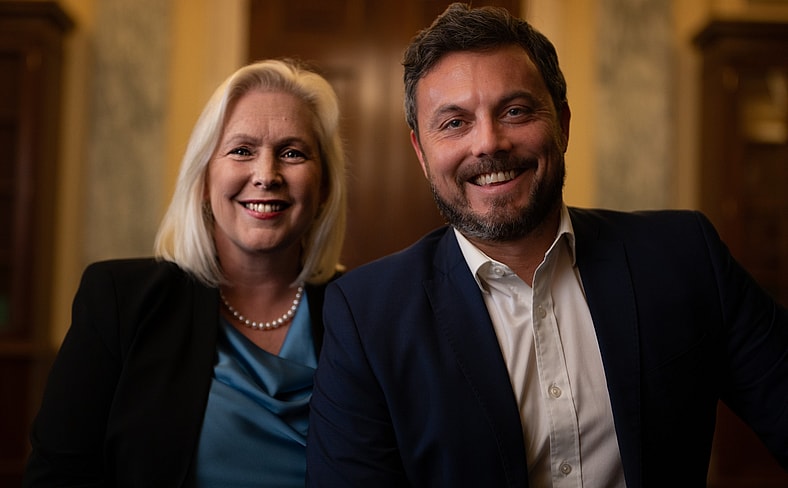 Sen. Kirsten Gillbrand with Age of Disclosure director Dan Farah – Credit: Photo by Vincent Wrenn / Farah Films
“I set off to make a serious, sober, credible documentary and stay away from sensationalism. I didn’t want to do anything that was sensational,” he says. “I’ve consumed every documentary, I’ve read every book on this topic. But I always wished that someone would make a very serious, credible documentary about this that only interviewed people who have direct knowledge of it, as a result of working for the US government.”
Farah became interested in the idea of non-intelligent extraterrestrial life when he was growing up on Steven Spielberg films like Close Encounters of the Third Kind and E.T. and watching TV shows like The X Files. He eventually became a film producer, and got to work with Spielberg on 2018’s Ready Player One. While watching the master work, he began to think about someday directing his own film. And he remembered his idea about making a serious UAP documentary.
“I came to conclusion that if I was ever going to direct something like this, it should be this documentary that I wish existed, and I would go try to create the documentary that I personally wanted to watch,” he says. The mission for me was to bring about the most credible, serious, non-sensational doc, that that only interviewed very credible people who have knowledge as a result of working for the U.S. government.”
The Age of Disclosure isn’t your typical basic-cable UFO doc with cheesy re-enactments and silhouetted talking heads speaking in scrambled voices. It includes 34 on-the-record interview with clearly identifiable current and former government officials including high-ranking members of the military and intelligence communities, and several elected officials.
The most recognizable is arguably Marco Rubio, the Republican Florida senator who was the vice chairman of the Senate Intelligence Committee when Farah interviewed him. He was subsequently chosen as Secretary of State and acting National Security Advisor for the second Trump Administration.
In the doc, he speaks bluntly about the need to understand UAP technology before the U.S.’s rivals do, as a matter of national security: “If their approach to it is driven by science and a desire to match what they think is ours, we’ll wake up one day and realize, ‘I don’t know how they got there, but they got there ahead of us, and now we’re screwed,'” Rubio says in the film.
The Age of Disclosure also includes interviews with a bipartisan list of lawmakers, among them Democratic Sen. Kirsten Gillibrand of New York, Democratic Rep. André Carson of Indiana, and Republican Sen. Mike Rounds of South Dakota, all of whom call for greater transparency around UAPs.
The White House and State Department did not immediately respond to requests for comment on The Age of Disclosure.
The Age of Disclosure and the ‘Tic Tac’ UAP
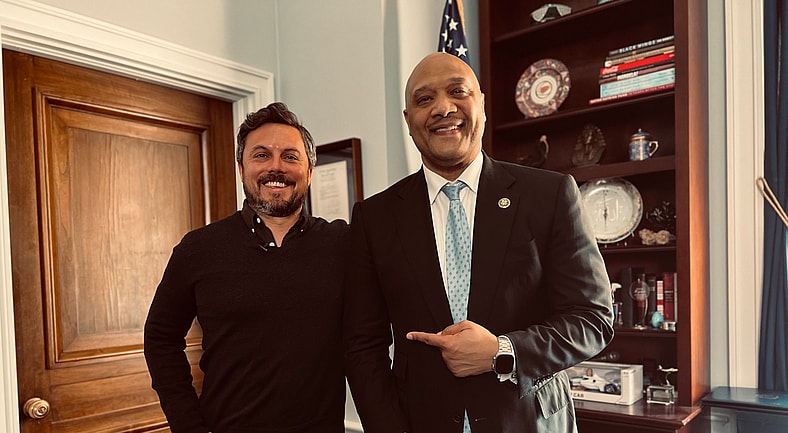 The Age of Disclosure director Dan Farah, left, with U.S. Rep André Carson (D-Indiana) – Credit: Photo by Vincent Wrenn / Farah Films
Among the mysteries the U.S. needs to understand, Farah contends, is the one surrounding the so-called “Tic Tac” UFO seen from the U.S.S. Nimitz off the coast of San Diego on November 14, 2004.
The film features a retired U.S. Navy fighter pilot, Cmdr. David Fravor, who says he was among those on board the Nimitz, a nuclear aircraft carrier, on strange day.
“I was the most senior person in the squadron flying. I had launched off Nimitz to do an air defense exercise off the coast of San Diego, California, and I ended up chasing a UAP known as the Tic Tac UAP. It was about 40 feet long, and just sitting there in space. You could kind of see it start to accelerate, and as it gets in front of us, it’s gone. This thing was doing 32,000 miles an hour. So obviously that technology is not [from] the United States.”
Similar accounts have come out before, including a 2017 New York Times report that quoted Fravor, and this PBS NewsHour interview with Navy Lt. Cmdr. Alex Dietrich, who is also featured in The Age of Disclosure.
“We describe it as looking like a Tic Tac,” Dietrich told PBS. “It looks like the little breath mint in larger scale, but white, oblong, no apparent flight control surfaces, no apparent visible means of propulsion. And it was maneuvering in a way that we didn’t recognize, that we couldn’t classify, we couldn’t identify.”
A 2021 report from the Office of the Director of National Intelligence detailed 18 incidents in which “observers reported unusual UAP movement patterns or flight characteristics.”
“Some UAP appeared to remain stationary in winds aloft, move against the wind, maneuver abruptly, or move at considerable speed, without discernable means of propulsion,” the report says
It concluded that “UAP clearly pose a safety of flight issue and may pose a challenge to U.S. national security.”
The Age of Disclosure also features an interview with retired Air Force Col. James Cobb, a former vice director of operations for NORAD, the North American Aerospace Defense Command, who recounts an incident in which multiple pilots tried unsuccessfully to intercept a mysterious craft: “We were unable to maintain air sovereignty over North America,” he says.
The film suggests that UAPs are monitoring our nuclear capabilities. Farah is ambivalent about where their origin may be: His interview subjects examine the possibility that they come from outer space, that they reside deep in the ocean, or that they may be from another dimensional.
“They talk about the possibility of them being extraterrestrial, and they talk about the possibility of being interdimensional. They talk about the possibility of them having been here all along with us, and of them being from here. A number of intelligence officials also make the point of saying it could be all of the above,” Farah says.
Why Are There No Clear Photographs of UFOs?
One of the main reasons so many people are so skeptical of UFOs or UAPs is that no one has taken a clear photo of one. At a time when everyone has a phone in their pocket, you would think someone would manage to get a clear shot of an alien spacecraft.
But The Age of Disclosure has an explanation for why that isn’t so.
Deep in the film, astrophysicist Eric Davis and electrical engineer and parapsychologist Harold Puthoff lay out the case that UAPs may operate within “warp bubbles,” powered by intense amounts of energy.” Davis theorizes that there would be “a different property of space time inside the bubble than on the outside of the bubble,” which could explain some of the unusual movements of UAPs.
“It’d be like riding space time in the same way that a surfer would ride a wave in the ocean,” Puthoff says. “Time is moving differently for people inside the bubble versus people outside the bubble. Whoever’s inside the craft would feel like they’re just cruising along. They wouldn’t be feeling the effects of what looks like speeds and accelerations that would turn a human being into pudding. This one breakthrough can be the key to interstellar travel.”
He adds: “We’d also have low observability, because the bubble acts as a barrier between two space time environments. … This is why radar would have difficulty tracking a craft, because the signal from the radar would be distorted by the energy field.”
The Age of Disclosure is now available on Prime Video.
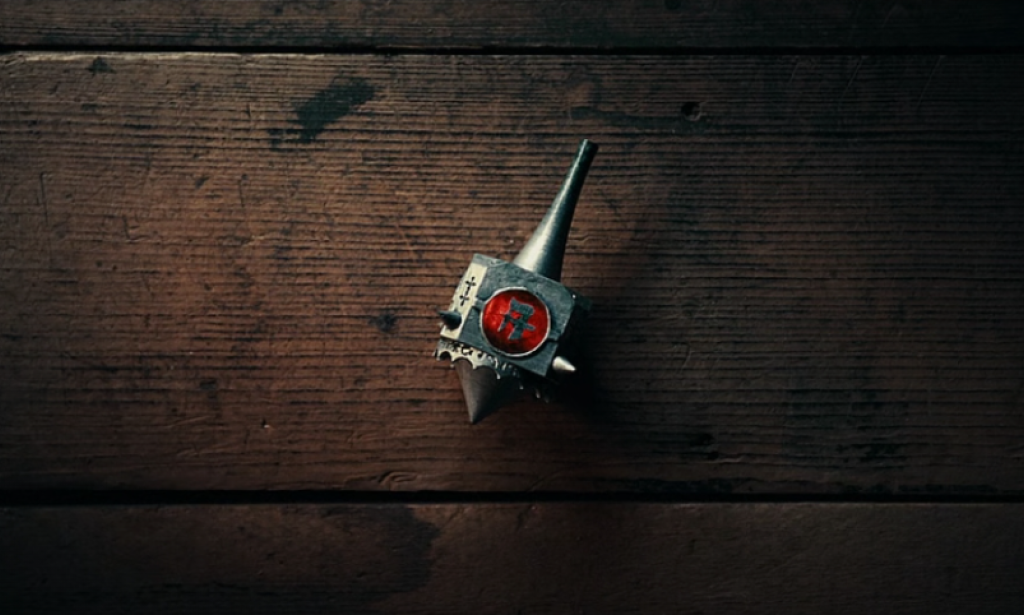
Main image: Video of the 2004 U.S.S. Nimitz “Tic Tac” incident, released by the Defense Department’s Advanced Aerospace Threat Identification Program.

You must be logged in to post a comment.