


When it comes to building a balanced, powerful physique, leg training is non-negotiable—yet it’s the most skipped workout for many gym-goers. Maybe it’s the intense soreness, the mental fatigue, or the misconception that legs don’t “show off” as much as arms or abs. But here’s the truth: strong legs are the foundation of overall strength, boost testosterone production (critical for full-body muscle growth), improve metabolism, and enhance athletic performance in every sport. With countless leg exercises out there—squats, lunges, deadlifts, leg presses—it’s tough to know which ones deliver the best results. That’s why we’ve created this definitive ranking of leg exercises, based on scientific muscle activation, functional strength, and real-world gains. Whether you’re a beginner looking to start strong or an advanced lifter aiming to refine your routine, this guide will help you focus on the moves that actually build thick, strong, shapely legs.
Why Leg Exercise Ranking Matters
Your legs are a complex muscle group, consisting of quads (quadriceps), hamstrings, glutes, calves, and adductors (inner thighs). Different exercises target these muscles in varying ways—some prioritize the quads, others the glutes and hamstrings, and a few hit the calves or inner thighs. The goal of this ranking is to highlight exercises that offer maximum “bang for your buck”: compound movements that work multiple leg muscles at once, stimulate high muscle growth (hypertrophy), build functional strength (useful in daily life and sports), and are scalable for all fitness levels.
We ranked the exercises from #1 (most effective) to #8, using these key criteria: 1) EMG (electromyography) data (measures muscle activation), 2) Ability to build both strength and size, 3) Versatility (works for beginners and advanced lifters), 4) Functional benefit (translates to real-life movements like walking, lifting, or jumping), 5) Low injury risk (when performed with proper form), and 6) Impact on hormone production (compound leg exercises boost testosterone more than isolation moves).
The Definitive Ranking of Leg Exercises (No.1 to No.8)
No.1: Back Squats – The King of Leg Exercises
Back squats take the top spot without question—they’re the single most effective exercise for building overall leg strength and size. EMG studies consistently show that back squats activate the quads, glutes, and hamstrings simultaneously, while also engaging the core and lower back for stability. They’re a compound movement that allows you to lift heavy weights, which is key for stimulating muscle growth and boosting testosterone levels.
How to do it: Stand with your feet shoulder-width apart, toes slightly turned out (15-30 degrees). Rest a barbell across your upper back (traps), grip the bar wider than shoulder-width. Keep your chest up, core braced, and back flat. Hinge at the hips and bend your knees to lower your body until your thighs are parallel to the floor (or slightly below, if flexibility allows). Push through your heels to return to the starting position. Aim for 3-4 sets of 6-10 reps.
Key form tips: Avoid rounding your back or leaning too far forward—this puts strain on your lower back. Keep your knees tracking over your toes (don’t let them cave inward). Drive through your entire foot, especially your heels, to engage the glutes and quads.
Modifications for beginners: Start with bodyweight squats or use a resistance band around your thighs (to help keep knees from caving). You can also use a squat rack with safety bars for confidence. Advanced variations: Try weighted back squats (add plates to the bar), front squats (shifts focus to quads), or pause squats (hold for 1-2 seconds at the bottom to increase tension).
No.2: Romanian Deadlifts (RDLs) – The Queen of Glutes & Hamstrings
If back squats are for overall leg mass, Romanian deadlifts (RDLs) are for targeting the posterior chain—glutes, hamstrings, and lower back. They’re a hip-hinge movement (not a squat), which makes them ideal for balancing out quad-dominant training and building strong, functional posterior muscles. RDLs also improve hip mobility and reduce the risk of lower back injuries.
How to do it: Hold a barbell with an overhand grip (shoulder-width) in front of your thighs. Stand with your feet hip-width apart, knees slightly bent (and keep them bent throughout the movement). Hinge at the hips, pushing your butt back, and lower the barbell along the front of your legs (shins to knees) until you feel a stretch in your hamstrings. Squeeze your glutes to return to the starting position. Do 3-4 sets of 8-12 reps.
Key form tip: Don’t round your back or bend your knees more as you lower the bar—keep your spine neutral and knees soft. The movement should come from your hips, not your knees.
Variations: Use dumbbells instead of a barbell for better balance (great for beginners). Advanced lifters can try single-leg RDLs (challenges stability and targets each leg individually) or weighted RDLs (add plates to the bar).
No.3: Front Squats – Quad-Focused Powerhouse
Front squats are a close third, and they’re the best exercise for targeting the quads specifically. Unlike back squats, which distribute weight more evenly between quads and glutes, front squats shift the load to the front of your body, forcing your quads to do most of the work. They also improve core strength and posture, as you have to keep your chest up to avoid dropping the bar.
How to do it: Stand with your feet shoulder-width apart, toes slightly turned out. Rest a barbell across the front of your shoulders (cross your arms to grip the bar, or use a “clean” grip with palms facing up). Keep your chest up, core braced, and back flat. Hinge at the hips and bend your knees to lower your body until your thighs are parallel to the floor. Push through your heels to stand back up. Do 3-4 sets of 8-10 reps.
Modification for beginners: Start with a lighter barbell or use a resistance band around your upper arms (to help hold the bar in place). If wrist pain is an issue, use a “crossed arm” grip instead of a clean grip.
Advanced variation: Try front squat jumps (explode up from the squat position) to add a plyometric element, which boosts athletic performance.
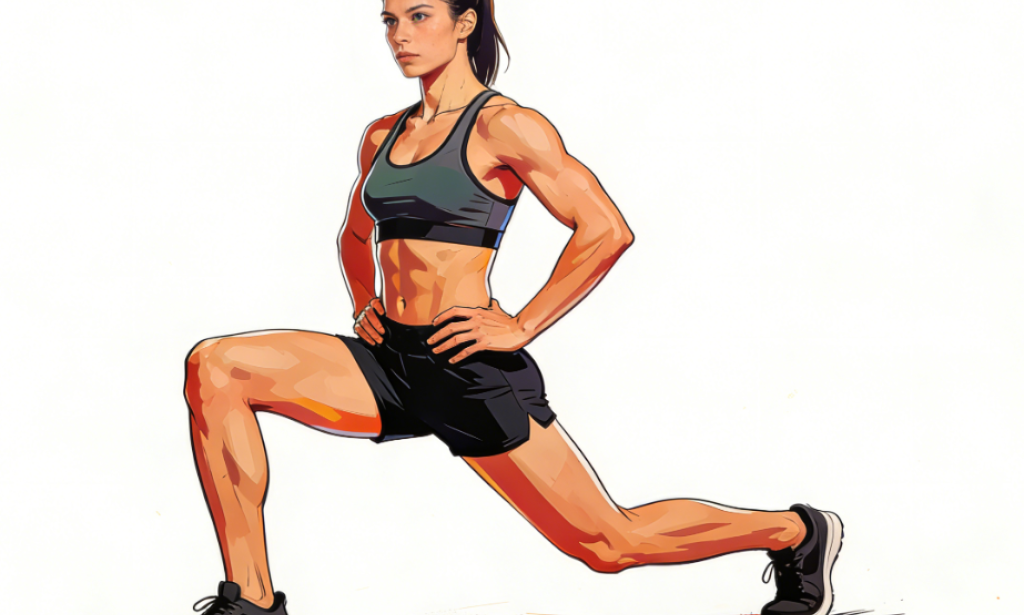
No.4: Lunges – Unilateral Leg Strength & Balance
Lunges are a unilateral (single-leg) exercise, which makes them essential for correcting muscle imbalances (most people have one stronger leg) and improving balance. They target the quads, glutes, and hamstrings, and can be done anywhere—with or without weights. Lunges also improve functional strength, as they mimic walking, running, and climbing stairs.
How to do it: Stand with your feet hip-width apart. Step forward with one leg, bending both knees to lower your body until your front thigh is parallel to the floor (back knee should hover just above the ground). Keep your chest up and core braced. Push through your front heel to return to the starting position. Alternate legs. Do 3-4 sets of 10-12 reps per leg.
Key form tip: Don’t let your front knee extend past your toes—this puts strain on your knee joint. Keep your front knee tracking over your toes.
Variations: Walking lunges (step forward continuously as you lunge), reverse lunges (step back instead of forward, easier on the knees), or weighted lunges (hold dumbbells or a barbell for added intensity).
No.5: Leg Press – Heavy Load Without Spinal Stress
The leg press is a machine exercise that’s great for building leg mass without putting stress on your lower back. It allows you to lift extremely heavy weights, which is ideal for stimulating muscle growth, especially for beginners or lifters with lower back issues. The leg press targets the quads, glutes, and hamstrings, and you can adjust your foot position to shift focus (higher feet = more glutes/hamstrings; lower feet = more quads).
How to do it: Sit in a leg press machine, place your feet on the platform (shoulder-width, toes slightly turned out). Adjust the seat so that your knees are bent at a 90-degree angle when your feet are on the platform. Grip the handles on either side of the seat, core braced. Push the platform away from you by extending your legs (don’t lock your knees), then slowly lower the platform back to the starting position. Do 3-4 sets of 10-15 reps.
Common mistake to avoid: Pushing with your toes instead of your whole foot—this reduces muscle activation and can cause calf strain. Also, don’t lower the platform too far (knees past 90 degrees), as this puts pressure on the knee joints.
No.6: Glute Bridges – Glute-Focused Isolation
Glute bridges are an isolation exercise that targets the glutes specifically—perfect for anyone looking to build a rounder, stronger posterior. They’re low-impact, easy to do, and can be done at home or in the gym. Glute bridges also improve hip mobility and core stability.
How to do it: Lie on your back, knees bent, feet flat on the floor (hip-width apart), arms at your sides. Press through your heels, lift your hips off the floor, and squeeze your glutes at the top (your body should form a straight line from shoulders to knees). Hold for 1-2 seconds, then lower your hips slowly to the floor. Do 3-4 sets of 15-20 reps.
Variations: Add a resistance band around your thighs (increases glute activation), or place a barbell across your hips (weighted glute bridges, for advanced lifters). Single-leg glute bridges (lift one leg off the floor) are also a great way to target each glute individually.
No.7: Calf Raises – Build Strong, Defined Calves
Calf raises are the go-to exercise for building calf muscles (gastrocnemius and soleus). Calves are often neglected, but strong calves improve balance, reduce the risk of ankle injuries, and add definition to your legs. Calf raises can be done with bodyweight, dumbbells, or a machine.
How to do it: Stand on the edge of a step (or flat floor) with your feet hip-width apart, heels hanging off the step. Hold onto a railing for balance. Rise up onto your toes, squeezing your calves at the top. Lower your heels below the step (to stretch the calves) for 1-2 seconds, then rise back up. Do 3-4 sets of 15-25 reps (calves are endurance muscles, so higher reps work best).
Variations: Seated calf raises (target the soleus muscle, done on a seated calf raise machine), or single-leg calf raises (challenges balance and targets each calf individually). Add dumbbells or a barbell for added weight as you get stronger.
No.8: Leg Curls – Hamstring Isolation
Leg curls are an isolation exercise that targets the hamstrings specifically. They’re great for balancing out quad-dominant training (common in people who do a lot of squats and lunges) and building hamstring strength, which reduces the risk of knee injuries. Leg curls are typically done on a machine, but can also be done with a resistance band.
How to do it: Lie face down on a leg curl machine, hook your ankles under the padded bar. Grip the handles on either side of the machine, core braced. Bend your knees to pull the padded bar toward your glutes, squeezing your hamstrings at the top. Slowly extend your legs back to the starting position. Do 3-4 sets of 12-15 reps.
Modification: If you don’t have access to a machine, use a resistance band—anchor the band to a sturdy object, loop it around your ankles, and lie face down, then curl your legs toward your glutes.
How to Build a Leg Workout Routine Using This Ranking
The key to effective leg training is balancing compound movements (for strength and mass) with isolation exercises (for targeting specific muscles). Aim to train your legs 2x per week (with 48 hours of rest between workouts) to allow for muscle recovery and growth. Here’s a sample weekly leg routine, based on the ranking:
• Workout 1 (Overall Mass Focus): 1. Back Squats (3x6-10), 2. Romanian Deadlifts (3x8-12), 3. Lunges (3x10-12 per leg), 4. Leg Press (3x10-15), 5. Calf Raises (3x15-25)
• Workout 2 (Quad & Glute Focus): 1. Front Squats (3x8-10), 2. Glute Bridges (3x15-20), 3. Walking Lunges (3x12-15 per leg), 4. Leg Curls (3x12-15), 5. Calf Raises (3x15-25)
Remember to apply progressive overload—gradually increase weight, reps, or sets to keep challenging your muscles. For example, if you can do 10 back squats with 60kg, try 65kg for 8 reps next time. If bodyweight lunges feel easy, add dumbbells in each hand.
Common Leg Training Mistakes to Avoid
Even with the best exercises, bad form can hold you back and cause injuries. Here are the most common leg training mistakes:
• Cutting Squats Short: Lowering your body only halfway (instead of thighs parallel to the floor) reduces muscle activation and limits growth. Aim to go deep enough so your thighs are at least parallel to the floor.
• Leaning Too Far Forward in Squats: This puts strain on your lower back and takes tension off your quads. Keep your chest up and core braced to maintain a neutral spine.
• Neglecting the Posterior Chain: Focusing only on squats (quad-dominant) leads to imbalances. Always include RDLs, glute bridges, or leg curls to target glutes and hamstrings.
• Using Momentum Instead of Muscle: Swinging your body or using momentum to lift weights (e.g., in lunges or RDLs) reduces muscle activation and increases injury risk. Focus on slow, controlled movements.
• Not Warming Up: Legs are large muscles—warm up with 5-10 minutes of light cardio (jogging, cycling) and dynamic stretches (leg swings, bodyweight squats) before lifting heavy. This increases blood flow and reduces injury risk.
Final Thoughts: Embrace the Leg Day Grind
Leg training is tough, but the rewards are worth it. Strong legs don’t just look good—they make every other workout easier (you’ll lift more in upper-body exercises with a strong base), improve your daily life, and keep you injury-free. Remember that progress takes time—don’t get discouraged if you can’t lift heavy weights at first. Focus on mastering form, being consistent, and fueling your body with enough protein (1.6-2.2g per kg of body weight) to support muscle growth.
If you’re a beginner, start with lighter weights and bodyweight exercises to build a foundation. As you get stronger, gradually add weight and try advanced variations. And don’t skip leg day—your physique (and hormones) will thank you.
What’s your least favorite leg exercise? Do you struggle with any of the moves in this ranking? Let me know in the comments below—I’d love to help you improve!

You must be logged in to post a comment.