


Defense-tech companies and artificial-intelligence startups have found a vital new market in President Trump’s rapidly escalating drug war. Weapons and AI platforms that were designed for a future conflict with China or struggled to prove themselves on the Ukrainian battlefield have found a niche in the administration’s tech-enabled crackdown on drug trafficking.
Drone and imaging companies are assisting the U.S. Coast Guard and Navy with interdiction operations in the Caribbean. AI companies from Silicon Valley to Dubai are pitching platforms that promise to map the hidden networks of fentanyl traffickers. On the southern U.S. border, a counterdrone system developed in Ukraine is being repurposed to deflect incursions from Mexico.
As Washington has revived the rhetoric and legal tools of the global war on terror, more companies large and small have staked their claims to the emerging market, at times retooling to fit the latest mission. They have rebranded their drones, sensors, AI tools and data platforms as custom tools for Trump’s fight against “narco-terror.”
The effort has accelerated since early September, when the U.S. military began an unprecedented campaign against small drug-trafficking vessels, executing strikes that have killed more than 80 people. Some regional allies have accused the U.S. of extrajudicial killings of civilians. The Trump administration maintains that drug cartels pose an imminent threat to America’s national security.
The legality of the boat strikes has been contested by U.S. lawmakers, foreign allies, the United Nations and human-rights groups. But the pushback mostly hasn’t deterred companies jockeying for a role in the Trump administration’s broader counternarcotics operations.
In an interview, Palantir Technologies Chief Executive Alex Karp declined to say whether his company’s technology was involved in counternarcotics operations, but voiced support for the strikes. “If we are involved, I am very proud,” Karp said. “I believe that fentanyl is a scourge on the working class of America and that if this scourge was affecting non-working-class people we would use extreme violence and so I support what they’re doing.”
While the administration’s upcoming national-defense strategy hasn’t been publicly released, people familiar with the document said much of it is devoted to homeland defense and hemispheric security—a significant shift toward the Western Hemisphere that gives concern over China a back seat.

“The counternarcotics mission has already opened new, unanticipated revenue lines,” said Aubrey Manes, senior director of mission at Vannevar Labs, a startup providing intelligence to national-security agencies. The company said it uses AI to help U.S. authorities uncover and disrupt drug-supply chains by mapping transnational criminal organizations and China-based suppliers, and to gauge public sentiment regarding U.S. operations against suspected Venezuelan drug boats.
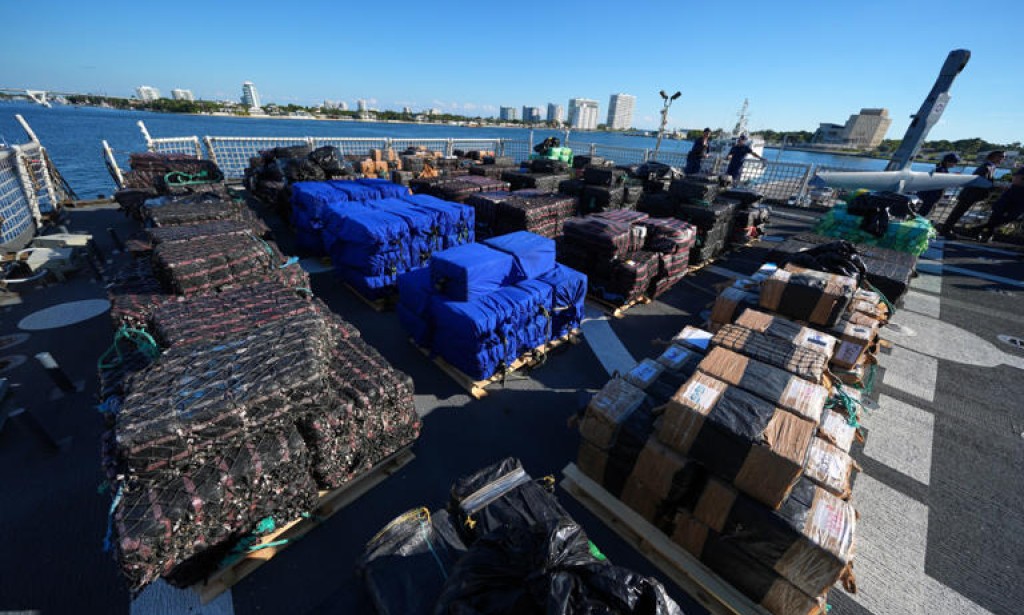
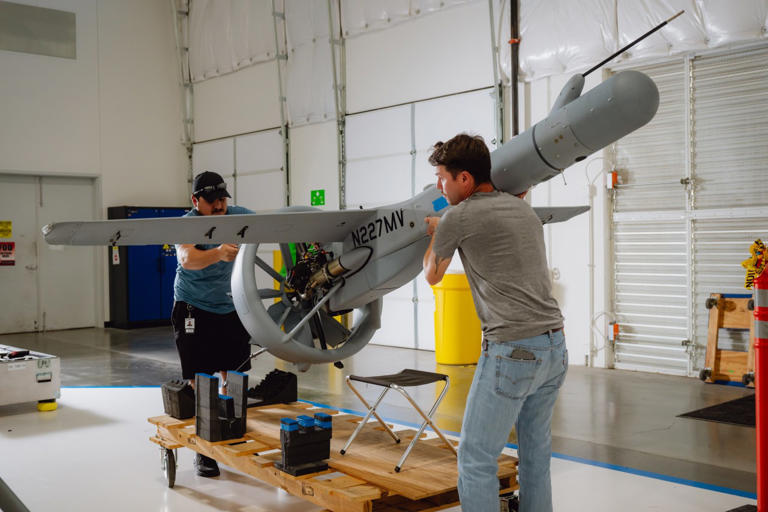
In November, the Coast Guard unveiled at Port Everglades, Fla., a record seizure of around 60,000 pounds of cocaine. Assisting in the operation was a drone from Shield AI, which makes surveillance drones that can be launched from ships and spend up to 13 hours flying over water, sending video feeds to operators and flagging possible targets.
During a press conference announcing the seizure, Brandon Tseng, co-founder of Shield AI, interrupted a Coast Guard official’s comments to cheer, “Hell, yes!”
Shield AI started in 2015 with the aim to offer reconnaissance in U.S. operations in the Middle East. After the U.S. wound down the wars in Afghanistan and Iraq, defense-tech companies such as Shield AI found that a pipeline flowing with billions of dollars in defense contracts had slowed to a trickle.
Setbacks last year, including a grisly testing accident in which a servicemember’s fingers were partially severed in the blades of one of the company’s V-BAT drones, caused Shield AI to miss its financial targets. The opportunity in counternarcotics opened a new chapter. Building on a $198 million contract it awarded Shield AI in 2024, the Coast Guard said it plans to add V-BATs to a dozen cutters, plus more on land near the U.S. southern border.
Anthony Antognoli, the Coast Guard’s program executive officer for robotics and autonomous systems, credits the V-BAT with more than $1 billion in narcotics seizures since the start of the year. A drone that can travel around 1,000 nautical miles, the equivalent of 1,150 miles, can do the work of 10 cutters, he said, allowing the Coast Guard to track and intersect people and drugs in the 4.5 million square miles it is responsible for covering.
“It is impossible to do that work with humans and patrol cutters alone,” Antognoli said.
The president’s spending bill in July gave the Department of Homeland Security an extra $165 billion over the next decade, including $6 billion to expand U.S.-Mexico “border security technology” such as surveillance. It also gave the Pentagon an additional $1 billion for antidrug and border missions. The Coast Guard received $4 billion more for cutters to patrol open waters and $350 million for robotics and autonomous systems.
“There’s priority and money,” said Mark Cancian, a senior adviser at the Center for Strategic and International Studies and a retired Marine colonel. “For business, that’s good.”
Since July, the Coast Guard has acquired several hundred aerial drones and undersea and surface vessels. “Our vision is to have robotics and autonomous systems as the foundation for the way the Coast Guard operates its missions,” Antognoli said. The Coast Guard’s priority right now, he said, is counternarcotics. “The narcotics threat to America is real and ever present and consistent,” he added.
The administration’s crackdown has transformed the perennially sleepy military zone of the Caribbean and eastern Pacific into a hub of activity.
U.S. Southern Command, which oversees operations in most of Latin America from Florida, tends to focus on chronically underfunded tasks including humanitarian missions. It has suddenly found itself at the center of an unprecedented lethal campaign. While it typically has a ship or two a month in the Caribbean, it now has a dozen or so ships, plus drones and other aircraft.
A Southern Command official asked lawmakers for more resources in February, arguing that the region is “an ideal setting for demonstrating new technologies” and a testing ground for robotic and unmanned systems in counternarcotics.
“We are really good at finding small boats,” said Greg Davis, chief executive of Overwatch Imaging, which makes airborne camera systems with superhuman vision that are bolted onto drones that are stationed on ships in the Navy’s Fourth Fleet in the Caribbean, and drones launching from California to patrol the eastern Pacific. “We get better intelligence, and better intelligence always helps,” he said.
The Defense Innovation Unit, a branch of the Defense Department that works to bring more startup innovation into the military, in September requested that startups pitch their best ideas for technology “capable of reliably stopping non-compliant small watercraft without placing undue risk to” people.
These counternarcotics missions are simpler than others that defense startups have pursued, said military strategists and company executives. Flying a drone over the Caribbean is easier than over Ukraine, where electronic warfare has rendered many American-made drones ineffective or unusable, and the distances are shorter than in a hypothetical China-Taiwan conflict. The drones sneaking over the border from Mexico, after being launched by drug cartels, are often Chinese off-the-shelf models—soft targets for jamming.
Foreign startups are also closely watching the shift in America’s defense priorities and positioning themselves for business opportunity. Rakia Group, a small company headquartered in Dubai, recently set up a U.S. subsidiary to pitch its AI tools to U.S. government agencies for countering drug trafficking, terrorism and illegal immigration.
Chief Executive Omri Raiter said its platform can connect the dots between activity on encrypted messaging apps, dark-web markets, boat and mobile-phone signals, social media and other data feeds to help investigators map trafficking routes that are hard to see. For example: spotting ships and containers whose movement or paperwork doesn’t match their weight or ownership records.
These companies are eager to put themselves “in a position that’s kind of of the moment in terms of the national-security discussions,” said William Hartung, a defense-spending expert at the Quincy Institute for Responsible Statecraft. “There’s a lot of money to be made.”
At the U.S. southern border, the Army is gathering the latest counterdrone technology to take down incoming drones deemed a threat. And it has enlisted Ukraine’s expertise: Moodro, a startup co-founded by a Ukrainian, Michael Obod, has technology to jam drones from up to around 10 miles away, and it is developing a longer-range version of its system for the Army.
“We put all of our investment in Ukraine first, but we see a lot of interest in the U.S.,” Obod said.
In January, the Army said, it is set to evaluate counterdrone and drone companies at a demonstration for the 101st Airborne Division at a base in Kentucky.
The Army awarded a counterdrone company, Epirus, $44 million for two of its new-generation systems, which are set to be tested in a few months. “It’s looking as good as it could look for us,” Chief Executive Andy Lowery said.
Epirus’s systems are designed to take down drones at close range, without damaging anything or anyone else around them. Lowery said his company wants no part of a more-literal war.
“I’m a strange cat, I’ve got a spiritual side of myself,” Lowery said. “If the government decides to use big guns and bring back the battleships, I’m not getting involved.”

You must be logged in to post a comment.