

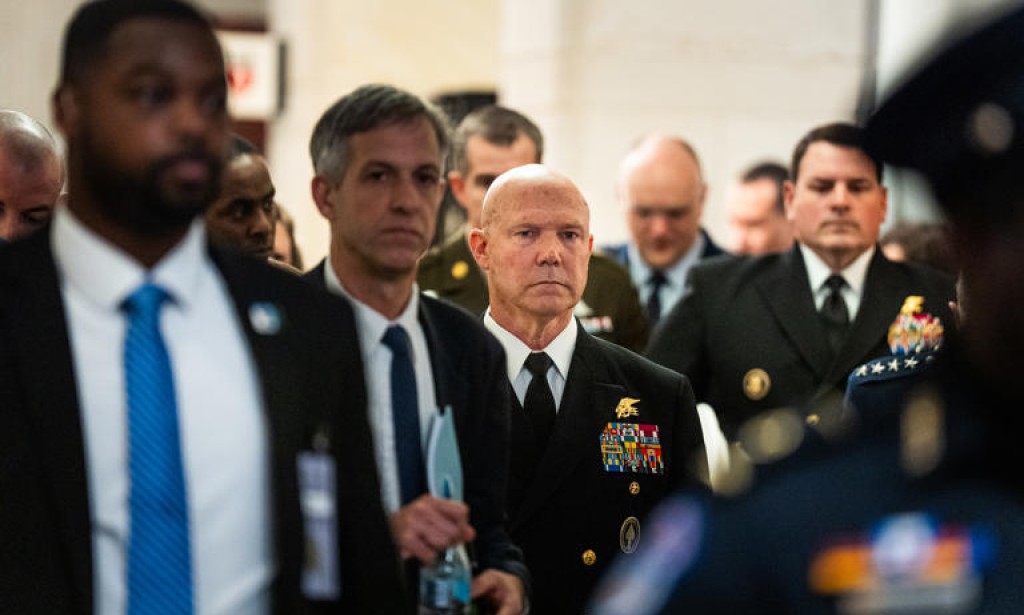

The recording was shown during a day of closed-door meetings on Capitol Hill featuring Adm. Frank M. Bradley, the commander who oversaw the Sept. 2 operation, which entailed four strikes in all. The attack killed 11 people, including the two people who survived the first blast that hit their boat.
Democrats emerged from the meetings alarmed and vowed to press ahead with nascent congressional inquiries scrutinizing the attack’s legality. Some Republicans who have been staunchly loyal to the Trump administration defended the operation — in some cases citing the same claims made by the president, who said the lethal campaign was necessary because the illicit drug trade is responsible for killing Americans.
Rep. Jim Himes (Connecticut), the House Intelligence Committee’s top Democrat, described the footage as “one of the most troubling things I’ve seen in my time in public service.” The two survivors, he said, were “in clear distress” after their boat was “destroyed.”
“The video we saw today showed two shipwrecked individuals who had no means to move, much less pose an immediate threat, and yet they were killed by the United States military,” Himes said in a joint statement with Rep. Adam Smith (Washington), the House Armed Services Committee’s top Democrat. “Regardless of what one believes about the legal underpinnings of these operations, and we have been clear we believe they are highly questionable, this was wrong.”
Sen. Tom Cotton (R-Arkansas), chair of the Senate Intelligence Committee, disputed the Democrats’ account. He called the repeated strikes “righteous” and said he would have given the same orders if he had been in Bradley’s position.
“The first strike, the second strike, and the third and the fourth strike on September 2nd were entirely lawful and needful, and they were exactly what we would expect our military commanders to do,” Cotton said.
Rep. Rick Crawford (R-Arkansas), who chairs the House Intelligence Committee, also said there was “no doubt in my mind about the highly professional manner” in which the attack occurred.
The September operation marked the start of the Trump administration’s deadly military campaign against boats and semisubmersible vessels suspected to be ferrying drugs off the shores of Latin America. To date, more than 20 vessels have been targeted by U.S. forces, and more than 80 people have been killed, according to disclosures made public by the administration.
The Defense Department announced its latest strike Thursday, saying four people were killed in the eastern Pacific Ocean. As with all of the others, the disclosure included no evidence verifying that those on board the vessel were drug smugglers or that their cargo included illegal drugs.
Democrats and experts on the law of war have called the killings illegal, arguing that criminal drug smugglers can’t be treated the same as enemy combatants waging war against the United States, and the footage shown to lawmakers for the first time Thursday is considered a crucial piece of evidence in determining whether the Sept. 2 strike amounted to a war crime.
Sen. Jack Reed (Rhode Island), the top Democrat on the Senate Armed Services Committee, called on the Pentagon to publicly release the full video and said he was “deeply disturbed” by what he witnessed. In a statement, he urged Republican colleagues to press on with the inquiry and said the meetings with Bradley must be “the only beginning of our investigation into this incident.”
Reed and his Republican counterpart, the committee chair Sen. Roger Wicker (Mississippi), were among the first lawmakers to publicly express their concerns about the Sept. 2 operation. Wicker declined to comment after exiting Thursday’s briefing.
Wicker and Reed jointly announced their inquiry after The Washington Post reported last week that Bradley ordered a subsequent attack on the vessel after survivors were identified, to comply with Defense Secretary Pete Hegseth’s spoken directive — issued before the operation’s initial strike — to kill everybody on board.
Bradley participated in at least five closed-door meetings over about eight hours Thursday. Two people familiar with his discussions throughout the day said the admiral confirmed that Hegseth had given a verbal order ahead of the operation to kill the passengers and destroy the boat. These people spoke on the condition of anonymity, because all of the sessions Thursday were classified. They were not authorized to identify the lawmakers to whom Bradley made this assertion.
Himes, the House Intelligence Committee’s top Democrat, told reporters after his meeting with Bradley that the admiral had conveyed to him and Crawford, the committee chair, that there was no order from Hegseth to “kill them all.” Cotton said the same after he emerged from his meeting with Bradley.
Spokespeople for U.S. Special Operations Command, where Bradley is the top commander, declined to comment.

Hegseth has sought to distance himself from the controversy, pointing instead to Bradley, while also defending the second strike that killed the two survivors. The Pentagon has denied The Post’s requests to interview Hegseth and review video footage of the strikes.
Bradley considered the survivors to be viable targets, not shipwrecked, defenseless mariners, according to Cotton and another person familiar with the briefing. The two survivors could have radioed for help from associates in the area and continued their “mission” of shipping drugs to American shores, Cotton said. It is not clear whether they attempted to do so or if they had equipment that wasn’t destroyed.
Calling for help could indicate the men were still able to move drugs, but it doesn’t make them combatants who pose a threat and can be killed, said Todd Huntley, a former military lawyer who advised Special Operations forces on the law of war for seven years.
One lawmaker familiar with Thursday’s briefings and the video that was shown said: “There was no boat. There was wreckage. There was no radio. There were two guys clinging to a tiny non-awash portion of the keel of a capsized boat.”
Military leaders told lawmakers that they assessed the survivors might “look” for a radio, the lawmaker said, speaking on the condition of anonymity because of the matter’s sensitivity. But it’s hard to see how they could after the first strike, the person said. The boat was consumed by a “massive conflagration — then it capsized,” the person said.
Some uniformed personnel who watched the second strike as it happened, or saw the briefing slides afterward, were disturbed by what they witnessed, said one former U.S. official familiar with the matter. “Basically it was, why are we killing people who are stranded and pose no threat?” the former official said.
Much of the scrutiny and expert analysis have focused on Bradley’s assessment that the survivors left after the first strike remained legitimate targets. U.S. and international law requires protection for combatants and others who cannot defend themselves and forbids further attacks. That includes “persons who have been rendered unconscious or otherwise incapacitated by wounds, sickness, or shipwreck,” according to the Pentagon’s law of war manual.
It is hard to see any argument that the follow-up strike was lawful, Huntley said, unless one accepts a series of premises: That the U.S. is in a war with drug traffickers, which a broad array of legal analysts dispute. That the two survivors were on board a seaworthy vessel and not at risk of drowning. That the drugs and the boat itself were military objects.
“You have to fulfill several variables,” he said. “It’s a pretty strained argument.”

The strikes have cast rare public scrutiny on decisions within the most secret corners of the military and the admiral tasked with leading the Pentagon’s most elite forces.
Bradley is a career special operator, and he has cultivated a strong reputation as a thoughtful and serious leader who looked out for his troops, said James Hatch, who served with Bradley at Naval Special Warfare Development Group, the unit commonly known as SEAL Team 6.
The admiral’s meetings with lawmakers came at a time when Republican-led committees are escalating their oversight of Hegseth and the U.S. military’s targeting of suspected drug traffickers.
Hegseth and members of the Trump administration have shifted their explanations for what happened during the operation since the second strike was revealed. In recent days, the defense secretary has said that he left the room where live footage of the operation was being streamed after the first strike and that he heard about the second strike hours later.
Hegseth said at a White House Cabinet meeting Tuesday that Bradley “made the correct decision to ultimately sink the boat and eliminate the threat.”
Bradley’s meetings on Capitol Hill could be the first step toward a more formal investigation, lawmakers and congressional aides said. Gen. Dan Caine, the chairman of the Joint Chiefs of Staff, also attended the briefings.
While some Republicans have continued to defend Hegseth’s leadership, several members of Congress and aides have said Republican support for the secretary and other top Pentagon officials has atrophied.

You must be logged in to post a comment.