


2025.08.13 11:10 (Updated 2025.08.13) | Wang Jiemin
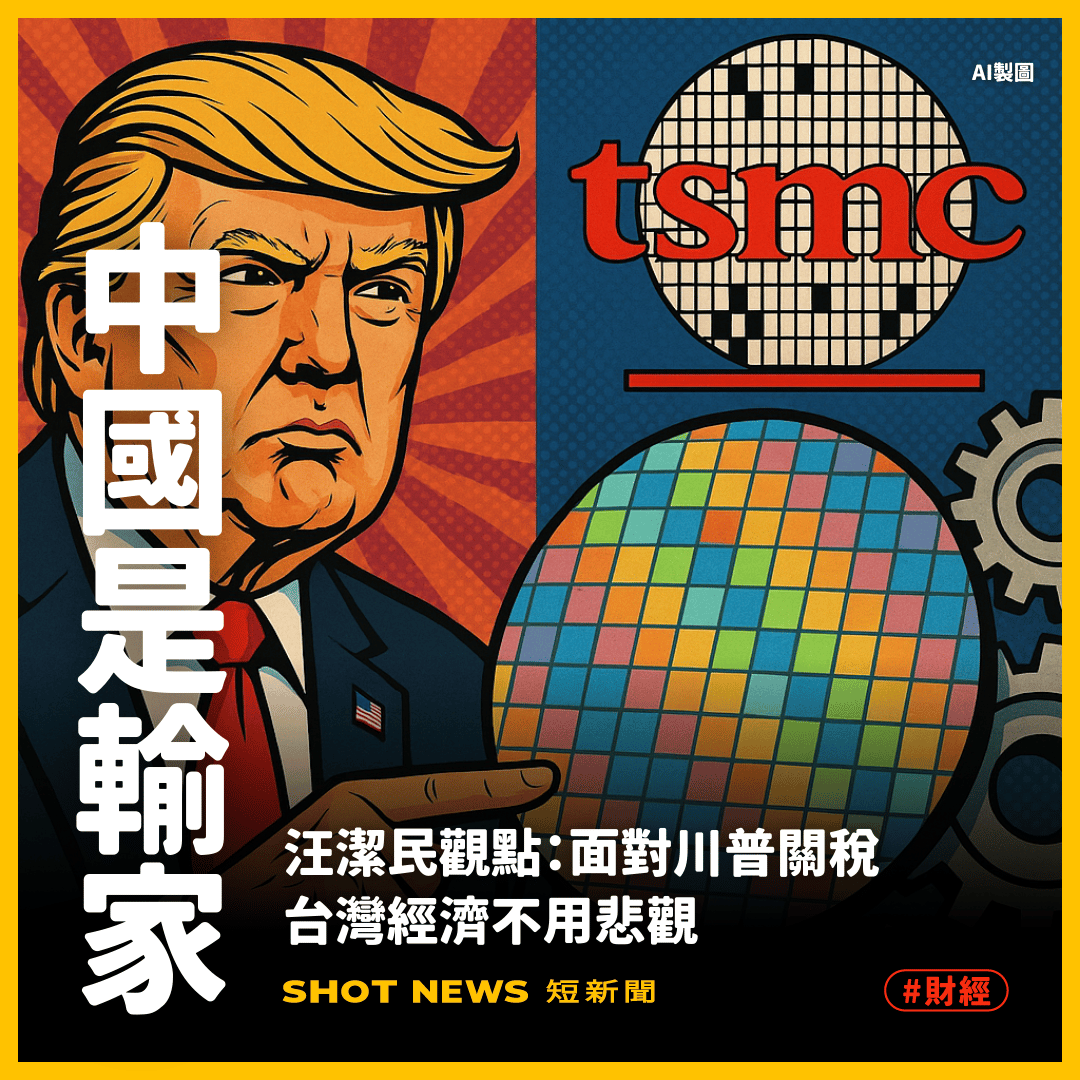
The semiconductor industry is the winner of Trump's tariffs, while China is the loser. The 100% semiconductor tariffs will inevitably impact China's mature manufacturing processes.
Wang Jiemin's view: Taiwan's economy need not be pessimistic in the face of Trump's tariffs.
Reciprocal tariffs are like a group of people walking down the street as usual when suddenly a heavy object falls from the sky and hits them—without warning and without any way to prevent it. So all the government can do is clean up the mess: those severely affected are sent to the emergency room and intensive care unit, those affected are treated according to their injuries, and then it's a matter of referral, care, and rehabilitation until they return to another form of daily life.
The US's sudden imposition of reciprocal tariffs (plus N tariffs) at varying rates on countries worldwide, particularly those with large trade deficits with the US, has three real objectives.
First, to make up for past unequal military spending, Europe has to invest $600 billion in NATO, while the US and South Korea have invested $350 billion, and Japan's expenditure was suddenly increased to $550 billion after the attack. Taiwan does not have US troops stationed there, so no additional investment is needed.
Second, rebuilding America's lost industries, most notably semiconductor manufacturing, steel and aluminum, ICT, basic science and technology, and pharmaceuticals. Therefore, the Office of the United States Trade Representative established Section 232 to address these industries Trump wants to re-establish in the US. Taiwanese screws, nuts, and steel, after deducting the 35% and 50% tariffs already set for non-Chinese products, fall under this category. This also forces China to reduce production. Of course, some countries disobeyed, such as Switzerland, which was subject to a 39% equivalent tariff plus N. However, two major Swiss pharmaceutical companies exported to the US were also subject to an additional 250% tariff. This reflects President Trump's deep resentment over the impact of COVID-19 on his election campaign. Fortunately, thanks to the foresight of TSMC Chairman C.C. Wei, who proactively invested $165 billion, Taiwan effectively avoided Trump's drastic measures and quickly penetrated the US, Japan, and future Germany and EU semiconductor supply chains, competing with top equipment manufacturers in these countries. The semiconductor industry is the winner of these Trump tariffs; the loser is China. A 100% semiconductor tariff will inevitably impact China's mature manufacturing processes.
Third, rebuild a democratic supply chain alliance led by the United States and use tariffs to strike at Chinese manufacturing. This can be done on two levels. One is China itself. This protracted negotiation is of substantial significance to Taiwan in basic metals, plastics and chemicals, and water hardware. Currently, China's 50%+N tariffs will cause Taiwanese businesses to shift their markets back to Taiwan or ASEAN. It will also indirectly help the machine tool industry, which has been most severely affected by the tariffs, to access markets outside the United States. However, in the plastics and chemicals industry, the most obvious reaction in the stock market is the overall rise of the four Formosa Plastics Group companies. In the face of the rapid rise of China's recycled plastics industry in recent years, Taiwan's traditional industries seem to see the light at the end of the tunnel.
On the other hand, it also benefits Taiwan by cracking down on China's practice of laundering products from China. The most notable example is Vietnam, which is subject to tariffs of 20%+N and 40%+N respectively. In order to encourage the Philippines, Thailand and Malaysia to accelerate their decoupling from China, tariffs of 19%+N are imposed. However, in response to Canada's failure to keep pace with Trump, tariffs are raised directly from zero to 35%. The purpose is clear: to achieve a scorched-earth policy and achieve mutual benefit through cooperation.
Taiwan is waiting for the finalization of tariffs under Section 232, which is most relevant to servers and ICT. However, judging from various aspects and Trump's remarks, it does not seem to be on Trump's most urgent agenda. At present, Trump's main concerns are resolving the war in Ukraine and purging the Democratic Party. Therefore, it can be seen that although the Taiwan stock market did not see a satisfactory index increase the day after Vice Premier Cheng Li-chun's remarks, 44 stocks still hit their daily limit, most of which were small and medium-sized stocks.
There is no need to be pessimistic about Taiwan's economy. The three important tasks ahead are: First, how to diversify the sales markets or transform industries affected by tariffs, such as machine tools, which is currently the industry most in need of government assistance. Second, to quickly take advantage of the situation where China is hit by US tariffs to expand the competitiveness of traditional industries in the US and ASEAN. Third, and most importantly, to make good use of Taiwan's relatively strong competitive technology semiconductor industry to connect with the US democratic industry.
It was no surprise that the opposition party launched a political distrust campaign based on tariffs, and they also encouraged some scholars to make statements detrimental to Taiwan. This is a challenge to Taiwan's democracy, but the reality is as TSMC's chairman pointed out in his July earnings call...
May TSMC prosper for ten years, and may Taiwan and the US seamlessly integrate in democratic industry!

You must be logged in to post a comment.