



2025.04.07 17:39 (Updated 2025.04.07) | Togo
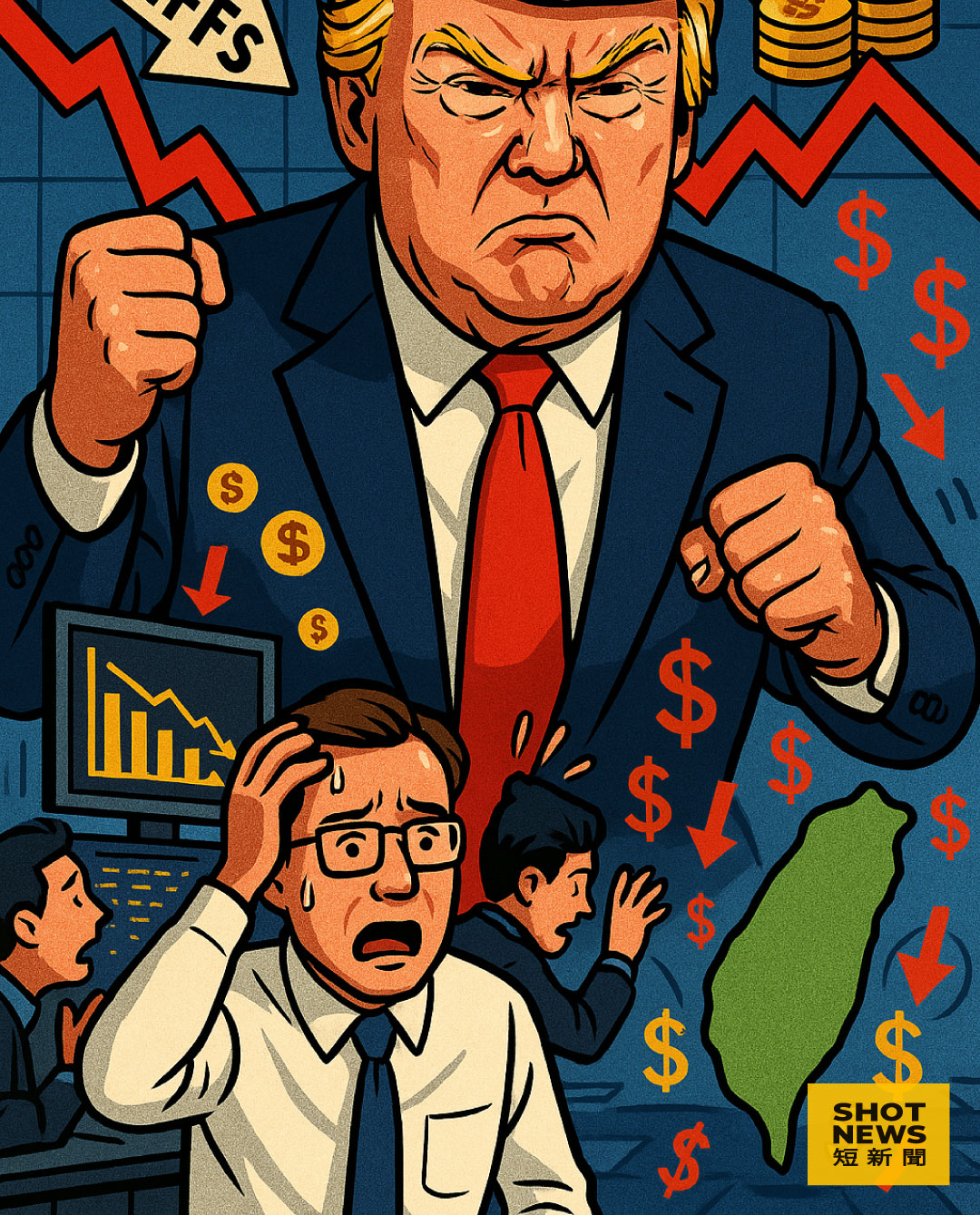
This time, Trump's targets are not based on friend or foe, but rather on countries he believes are taking advantage of the United States.
Who benefited from the US?
Despite the Qingming Festival holiday, the Taiwan stock market was not spared from the storm of Trump's tariff war, instead experiencing a catch-up decline. Almost all stocks hit their daily limit down on Monday's opening, with trading volume shrinking. Those willing to cut their losses couldn't sell, brewing serious systemic risk. Strangely, the three major institutional investors actually bought a net NT$15.6 billion. Was this due to unsold sell orders, or genuine bargain hunting? This warrants further observation.
Although the Taiwan stock market lost nearly 10% in a single day, it is not the biggest victim of Trump's tariff war. Global stock markets plummeted, and the four major US stock indices also fell sharply. If Trump's tariff war is a "seven-injury fist," it is unclear whether the US or the countries subject to high retaliatory tariffs are the ones that are most severely hurt. As a result of this battle, the market value of the seven major US tech companies has shrunk significantly, and they are no longer the invincible giants they once were.
By the time the Taiwan stock market opened on Monday, it had already fallen 3,000 points from its peak. Adding Monday's 2,000-point drop, the total decline is 5,000 points, placing it among the worst-performing stock markets globally. This is a far cry from the strong performance of the previous two years. Notably, while foreign investors are projected to sell NT$695.1 billion worth of Taiwan stocks in 2024, by April 7th of this year, foreign selling had already reached NT$670.8 billion, almost equivalent to the entire previous year. This clearly indicates that foreign investors are not optimistic about the outlook for the Taiwan stock market.
A sharp drop followed by a rebound, buying on dips, is an ironclad rule of investing. The key is determining where the bottom is. The Taiwan stock market has already fallen 5,000 points in this wave, and theoretically, it should be time to gradually accumulate positions. However, it cannot be ignored that this global stock market crash was indeed triggered by Trump's tariff war.
Trump's style of action is drastically different from that of his first term and Biden's. During his first term, Trump clearly targeted China, which led to the US-China trade war. But this time, Trump is targeting countries he believes are taking advantage of the US, regardless of whether they are friend or foe. This has expanded globally. Furthermore, in geopolitical conflicts, he demands that allies share the responsibility and financial burden of defense, even at the cost of offending allies everywhere.
In other words, Trump is not employing the Communist Party's united front tactics of "uniting with secondary enemies to attack primary ones," but rather adopting a self-centered approach, confronting the entire world, and attempting to create a blueprint for America's greatness again.
Therefore, Trump may face several challenges: First, the escalation of the tariff war could lead to a global economic recession, but also "stagflation" with rising inflation. More seriously, a severe economic recession could be accompanied by a sharp deterioration in inflation, similar to the Great Depression in the US and Europe after 1930. Second, Trump's anti-immigration, anti-China, and anti-ASEAN policies will cause a sharp increase in US manufacturing costs, eliminating the availability of cheap necessities. This will inevitably lead to rising inflation.
Trump's ambition to rebuild America is admirable, but his tariff war rhetoric is based solely on the significant U.S. trade deficit in goods, ignoring the fact that the U.S. has a huge surplus in services trade, which more than compensates for the trade deficit in goods. Furthermore, the quality of services trade far surpasses that of goods trade; therefore, the U.S. may not actually be being taken advantage of by its trade rivals as Trump claims.
Therefore, setting the equivalent tariff rate based on the trade deficit ratio may not reflect the reality of global trade. Given the strength of the US economy, a clash with a major global trading partner could lead to a major disaster. Thus, whether to buy Taiwan stocks at this time remains highly uncertain and requires caution.

You must be logged in to post a comment.