



Students attend classes in the basement of a municipal building in Bobryk, Sumy Oblast, Ukraine (September 1, 2025).Image source: Evgeniy Maloletka/AP Photo/picture alliance
(Deutsche Welle Chinese) After Russia's full-scale invasion of Ukraine in February 2022 , many Russian-speaking Ukrainians decided to stop speaking Russian in their daily lives and speak only Ukrainian .
As time went on, this initial impulse seemed to subside, and some Russian-speaking Ukrainians reverted to their old habits. A significant number of students, and even some teachers, still communicate with each other in Russian.
However, according to a study conducted in April and May 2025 by the National Agency for Quality of Education of Ukraine (SSEQU) and the Commissioner for the Protection of the Language of Ukraine, the use of Ukrainian in schools continues to rise. Approximately 48% of the students surveyed said they communicated with each other only in Ukrainian, an increase of 7 percentage points from the previous school year.
However, this situation does not apply to all regions. The opposite trend has emerged in the capital, Kyiv: the proportion of students who speak only Ukrainian has decreased by 10 percentage points, falling to 17%.
Oksana (pseudonym) is a teacher at a school in Kyiv. She told Deutsche Welle, "The children speak Ukrainian in class, but as soon as the bell rings, they start communicating in Russian." She added, "One boy even wanted to speak Russian in class. He speaks Russian at home and doesn't understand Ukrainian."
Irina, a student at another school in Kyiv, had a similar experience. “Most of the girls in my class speak Ukrainian, but almost all the boys speak Russian,” she said.
She speaks Ukrainian at home and school, and occasionally Surzhk, a mixed Russian and Ukrainian language widely spoken in some areas.
Many displaced people in Ukraine speak Russian.
Olena Ivanovska, Ukraine's National Commissioner for the Protection of Languages, attributes the decline in Ukrainian language use among students in Kyiv to the large influx of displaced people from eastern Ukraine, regions historically the largest Russian-speaking areas.
Oksana agreed with this view and mentioned a student from such a family: "She spoke to me in Ukrainian, but when her father came to pick her up, she immediately switched to Russian."

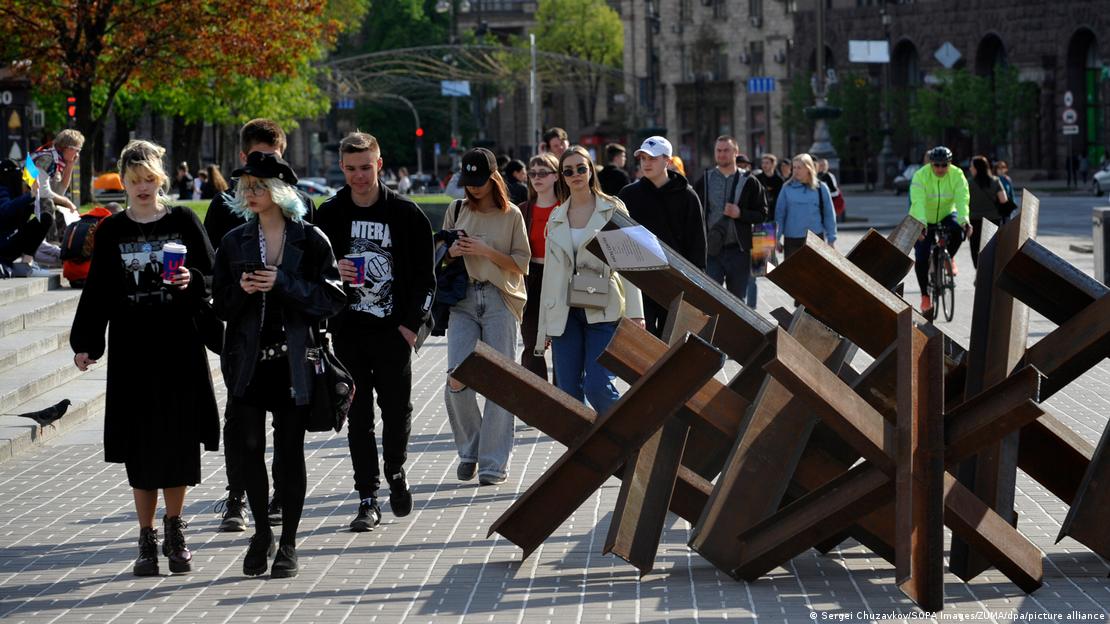
Oleksiy Antypovych, a sociologist and head of the "Rating Group" at the Ukrainian research institute, is not surprised that so many people in the Ukrainian capital speak Russian.
He told Deutsche Welle, “In Kyiv, about 50% of the population speaks Ukrainian, slightly less than 20% speak Russian, and 30% speak both languages. In fact, the number of Russian speakers in Kyiv is twice the Ukrainian average,” citing a study by the “Rating Group.”
“At the outset of the full-scale invasion, a massive internal mobilization took place in Ukraine to protect national symbols,” he explained. Since 2024, “Russian has reappeared on the streets. Especially in Kyiv, speaking Russian is no longer seen as something to be ashamed of.”
However, he pointed out that the proportion of the population using Ukrainian in daily life has remained stable.
Patriotism alone is not enough.
Ivanovska believes that much work remains to be done to create a Ukrainian-speaking environment outside the classroom.
“Patriotism alone is not enough. It requires national will and a coherent policy on what language teachers and school administrators use.”
Therefore, she believes it is crucial that "parliament passes a bill ensuring educational institutions have a Ukrainian-language environment."
The bill, registered in October 2024, defines the term "Ukrainian language learning environment." It stipulates that the educational process includes not only classroom instruction but also breaks, interactions on campus, and other educational activities. If passed, the bill will obligate authorities to establish a system for assessing children's language proficiency. However, the bill does not stipulate any measures to punish students or parents who communicate in Russian.
Ivanovska said, "We also need to make parents who speak Russian with their children at home understand that these children will be at a significant disadvantage when they enter school compared to children whose native language is Ukrainian."
Ivanovska stated that laws alone are not enough; high-quality Ukrainian language teaching materials are also essential.
Ukrainian popular culture urgently needs development
Valentina, the mother of a seventh-grade student at another school in Kyiv, believes there is another reason why so many students speak Russian.
“I think it’s because Russian-language content dominates on YouTube and social media. The online games they play are also in Russian,” she told Deutsche Welle.
Andriy Shymanovski, a well-known Ukrainian blogger, also stated that Russian pop culture has a significant impact on children.
“We don’t have the wonderful content about experiments, pranks and challenges created by Ukrainian children’s bloggers,” he told Deutsche Welle.
He said the reason children share Russian content is that they find it more interesting. "If there's nothing funny in Ukrainian, we're at a disadvantage. Besides, kids these days love playing shooting games, most of which aren't even in Ukrainian. That's why we need a wide variety of Ukrainian content, not just academic content."

You must be logged in to post a comment.