

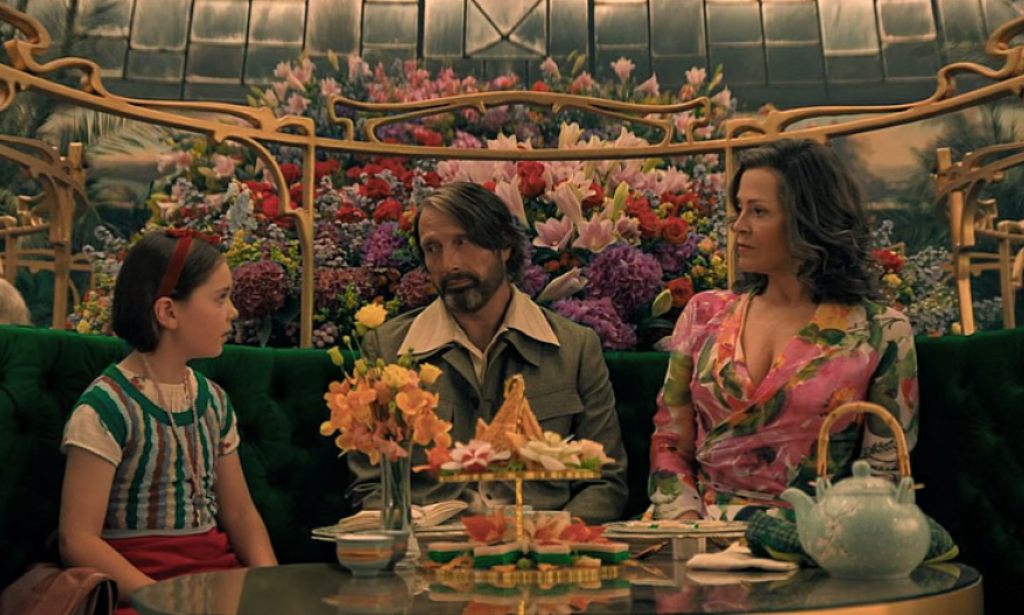

Though he created and led the shows Pushing Daisies and Hannibal, Bryan Fuller never directed episodes. So he wanted his directorial feature debut, Dust Bunny, to be about something deeply important to him.
And maybe important to the kids who will see it, as well.
“There’s that adage about 10,000 hours of experience,” Fuller says, “and I definitely had that under my belt as a showrunner. You’re the director of directors. I am heavily involved in the design and style of a show. As someone who loves aesthetics and finds great emotion in them, that background gave me the ability to communicate all the things we were trying to achieve.”
Fuller had a simple pitch for Dust Bunny: “A little girl hires a hitman to kill the monster under her bed.”
The family horror film bursts with as much color as gunfire in a giddy genre mash-up of action and monsters.
 Sophie Sloane and Mads Mikkelsen in Dust Bunny. Roadside Attractions – Credit: Roadside Attractions
The bunny of the title is a beast under the bed of young Aurora (Sophie Sloan). When it eats her foster parents, she seeks protection from her neighbor, Resident 5B (Mads Mikkelsen). Along their fairy-tale journey, they face off against assassins, the Queen of Killers (played by Sigourney Weaver), and Dust Bunny.
To Aurora, emotions can be as scary as monsters and as thrilling as action. She fights through everything — much like Weaver’s famous heroine in the Alien films, Ripley.
“I talked with Sigourney about how characters like Ripley or Geneviève Bujold in Coma were the women I grew up admiring as symbols of righteousness and goodness,” Fuller says. “As a queer person, they were my heroes. Sigourney said, ‘It’s funny you found power in Ripley; I see her as someone who didn’t have power and had to find it.’
“I told her, ‘That’s why she matters so much, not just to queer kids, but to anyone who feels marginalized or powerless. To look at Ellen Ripley and say, ‘If she can survive, I have a chance.’
“That’s such an important message in Aurora: Despite being a little girl, she kept rescuing herself again and again until someone came to help. I hope people who need that encouragement will find something in Aurora they can relate to and be inspired by.”
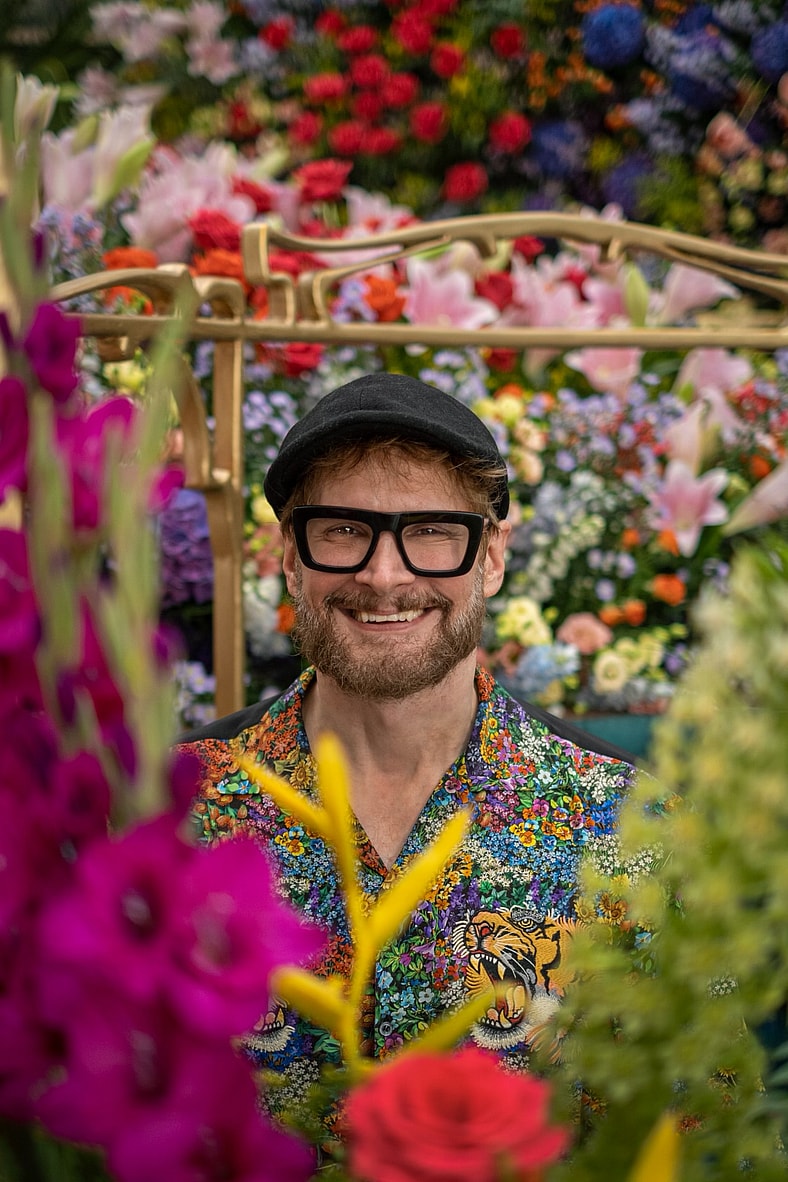 Dust Bunny director Bryan Fuller. Roadside Attractions
Bryan Fuller on Reuniting With Mads Mikkelsen for Dust Bunny
The project is a reunion between Fuller and his Hannibal star, Mads Mikkelsen, who plays both an anti-hero and surrogate father. The actor’s stoicism and jumpsuits pop as brightly as the candy-colored action.
“Mads is a huge Bruce Lee fan, and I wanted him in a yellow tracksuit, fighting with nunchucks,” Fuller says. “It’s pure wish-fulfillment for him. When Mads came in for his fitting, he said, ‘I’ve been trying to figure out who this guy is, who would wear all these clothes, and I finally had to give up and trust you.’”
Dust Bunny was originally planned as an episode of the 2020 reboot of Steven Spielberg’s Amazing Stories, but the series was canceled. The original show debuted in 1985 and was an early production by Amblin Entertainment, the company Spielberg co-founded.
“There was something about the Amblin brand of high-concept, emotional storytelling,” Fuller says, “that gave you an adventure, that gave you young people in danger, that excited me growing up. Seeing those films was appointment viewing, in a way we’ve kind of lost in the cineplex.”
When Fuller was writing Dust Bunny, his playlist included composers Alexandre Desplat, Jerry Goldsmith, and the man behind the Bride of Frankenstein score, Franz Waxman. In the vein of the classic Universal Monsters, Fuller wanted to see the humanity in his big and furry titular creature.
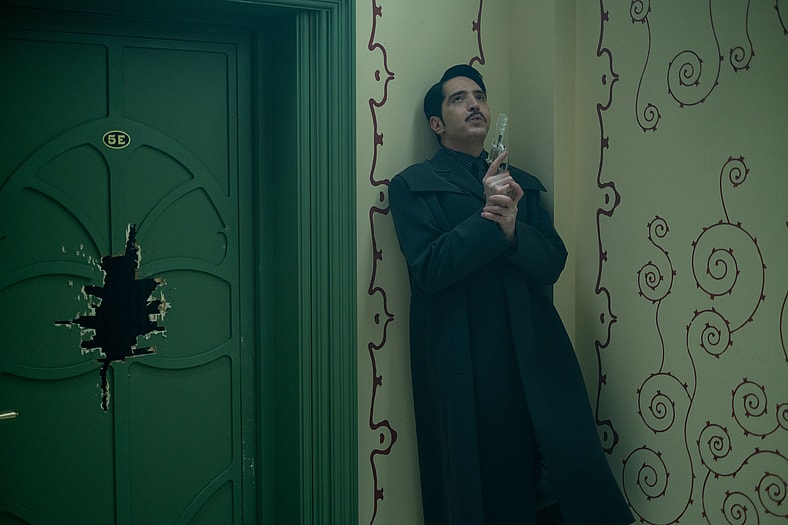 David Dastmalchian in Dust Bunny. Roadside Attractions – Credit: Roadside Attractions
“I found Universal Monsters so insightful about the human condition and monstrosities,” Fuller says. “Often, we remember the snapshots of those films and usually the monstrous poses, but they are three-dimensional characters with yearning and pain and being marginalized. I find them deeply relatable.”
Fuller is no stranger to writing outsiders concealing their true nature, from Ned talking to the dead in Pushing Daisies or Mikkelsen’s version of Dr. Lecter in Hannibal.
Fuller and his cinematographer, Nicole Hirsch Whitaker, talked often about the “flavors” of color they brought to the film’s palette. They wanted an aesthetic both savory and sweet.
“Our movie was mango chicken, not something purely savory like Hannibal or purely sweet like Pushing Daisies,” Fuller says. “We drew inspiration from French cinema. I’m a big fan of French maximalism.”
Bryan Fuller on POV
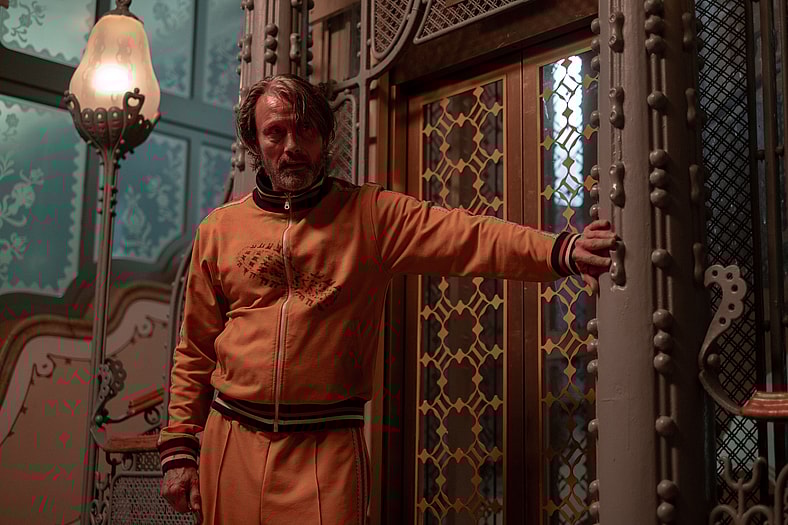 Dust Bunny reunites writer-director Bryan Fuller with Hannibal star Mads Mikkelsen. Roadside Attractions – Credit: Roadside Attractions
Fuller says among the films they discussed were The Umbrellas of Cherbourg, The City of Lost Children and La Femme Nikita, because all had such strong points of view.
To express Aurora’s perspective, Fuller and Whitaker toyed with ARRI lenses, and detuned anamorphics to dial up the anxiety and isolation.
“We were going through lenses that we pulled, and Nicole removed the matte board at one point,” Fuller said, “and we had this wonderful 3:1 aspect ratio. We looked at the frame and thought, ‘Is there any reason we shouldn’t shoot this in 3:1?’ Because looking at the frame and looking at the model that we had on the other side of the camera, it created a psychological space that captured Aurora’s plight.”
From Aurora’s perspective, ceilings are tall and hallways are long. Her apartment building is funky and timeless, with its gated elevator, warm colors, and painted snakes along the stairwell.
The film took advantage of the historic locations in its shooting location, Budapest.
“Location scout Marci Bálint showed us the refurbished Hungarian Treasury Building,” Fuller says. “We debated: Should we choose something more traditional, something that felt specifically European? Not that the apartment building we landed on didn’t feel European in that sort of Beaux-Arts, Art Deco extravagance. Once we settled on that location, it informed the look of this film.”
Outside the apartment, the world is an animal kingdom. Production designer Jeremy Reed packed Aurora’s apartment and other locations, including a shark-infected restaurant in Chinatown, with vibrancy and symbolism.
“There’s a Chinese zodiac through-line running through many of the characters — snakes, chickens, dragons, pandas,” Fuller explains. The production even considered shooting scenes at a European zoo, but Fuller and his crew felt that the conditions for the animals were inadequate, and that didn’t sit well with them.
The director, accustomed to television’s hustle and bustle, relished exploring character and story with his department heads like never before.
“With showrunning, you’re constantly looking ahead,” Fuller says. “As soon as you finish shooting, you’re prepping the next one while still filming, so you rarely live in the moment. Directing let me have a more intimate experience — to live with the actors and department heads, to build meaningful relationships — rather than flying at 30,000 feet as a showrunner, clearing the road ahead.”
Trust was essential to Dust Bunny. Fuller says Sheila Atim, who plays an action-ready social service worker, epitomized the communal atmosphere he seeks.
“Sheila often stood right next to the stunt performers,” Fuller recalls. “She called out before another take: ‘Bryan, I think the stunt guy’s hurt. I don’t think he can do another one.’ She noticed things I couldn’t see from behind the camera. People looking out for each other, reinforcing that let’s-put-on-a-show energy you hear about in old Judy-and-Mickey stories from classic Hollywood.”

You must be logged in to post a comment.