

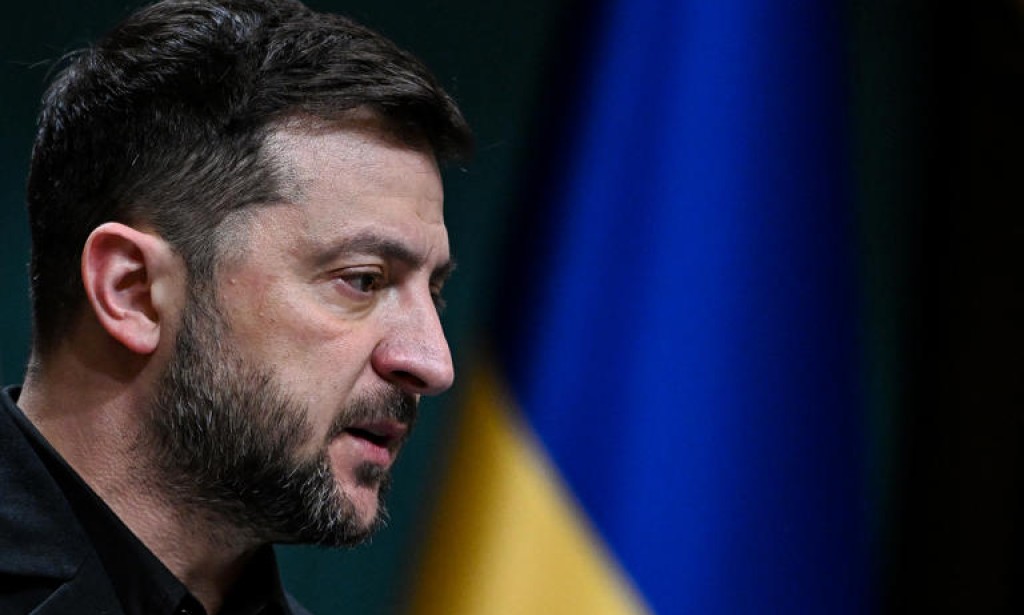

The abrupt resignation Friday of Zelensky’s chief of staff, Andriy Yermak, who was also serving as lead negotiator with the United States, came just hours after his home was searched by anti-corruption authorities.
Soon after, Russia unleashed hundreds of drones and missiles on Ukraine, killing two people in Kyiv and wounding dozens of others. By morning, more than a half-million residents of the capital were left without power.
Meanwhile, Washington remains set on finalizing a controversial deal to end the war, with President Donald Trump’s special envoy, Steve Witkoff, expected in Moscow next week and the revised Ukrainian delegation already en route to the U.S. for more talks.
Rustem Umerov, who heads Ukraine’s National Security and Defense Council, was tapped to replace Yermak as lead negotiator — a move that is facing domestic criticism as suspicions swirl that he too may be implicated in the widening corruption scandal.
As that team hammers through key details of a peace plan, opposition lawmakers are also calling for Zelensky to unify the country by replacing key ministers and backing a new coalition in parliament. The justice and energy ministers already resigned this month after they were accused of ties to the corruption scandal. Those positions have proven difficult to fill, as candidates fear joining the government at an uncertain moment could risk their reputations nearly four years into the full-scale war
Zelensky will have to manage this multitude of crises as he also seeks a candidate to replace his most loyal aide, who was widely criticized for consolidating power in the presidential office and disrupting the work of career diplomats but for years maintained Zelensky’s trust for the most sensitive wartime tasks.
“Yermak’s resignation for Zelensky is almost like cutting off his right arm,” said Ukrainian political scientist Volodymyr Fesenko. “It’s extremely painful — physically and psychologically. A psychological vacuum will appear around Zelensky. Yermak was always next to him.”
“But Zelensky is adaptive. He learns quickly,” Fesenko added. “I don’t think it’s a catastrophe — but it is a serious challenge.”
Just days ago, Yermak sat across from U.S. Secretary of State Marco Rubio in Geneva as Kyiv negotiated key changes to a drafted peace plan that initially made major capitulations to Russia.
Although his resignation could be interpreted as a disruption to the peace process, observers said it should instead bolster the reputation of Ukraine’s anti-corruption efforts.
“One thing that genuinely reassures me: Andriy Yermak seems to be out of the negotiation loop,” Ukrainian opposition lawmaker Inna Sovsun wrote on X. “The idea of talks led by someone whose credibility is so badly damaged was frightening. Whatever the backstory of his removal, putting him in charge of a negotiating team now would be a clear risk to Ukraine’s interests — and to any trust in the process.”
Yermak’s resignation was widely welcomed in Ukraine, but many are calling for Zelensky to go further to maintain the trust of the population and dispel suspicions that more top officials participated in a scheme to siphon off money from the defense and energy sectors as soldiers go without adequate weaponry and civilians endure constant blackouts.
“I see no conclusion drawn by Zelensky,” Ukrainian lawmaker Volodymyr Ariev wrote in a message to The Washington Post. “He resigned one corruption scandal [figure] and appointed as the head of the negotiating team another one.”
Zelensky needs to adjust “to the real changes required” by the public, Ariev added. Ukraine needs officials who are not loyal to the president “but professional and oriented to defend Ukraine’s interests.”
Ukraine’s anti-corruption bureau, NABU, has already named several people close to Zelensky, including his former business partner Timur Mindich, as participants in a major kickback scheme — the details of which continue to leak out, hampering public trust in the government.
A summer crackdown on NABU, fueled by allegations the agency was infiltrated by Russian agents, spurred massive street protests for the first time during the full-scale war. Many view that effort as an attempt to silence detectives investigating top officials implicated in major graft, including one NABU employee involved in the probe and his father who remain in jail on treason allegations. Public calls mounted for their immediate release Friday, adding more pressure on Zelensky at a critical moment for the country.
Yermak, meanwhile, told the New York Post he would soon report to the front line, defending himself as an “honest and decent person.”
Late Friday, Zelensky warned in a Telegram post that “Russia is eager for Ukraine to make mistakes.”
“We won’t make any,” he wrote. “If we lose our unity, we risk losing everything – ourselves, Ukraine, and our future. We must stand together.”
Top officials reiterated messages of unity Saturday, as the capital reeled from 10 hours of overnight bombing that left civilians sheltering in underground subway stations, corridors and bathrooms. The relentless attacks were not more deadly in large part because of air defense provided by the U.S. and other partners — support that Kyiv cannot risk losing.
“Russia’s attack is a demonstrative response to all peace initiatives of Ukraine and our partners,” Foreign Minister Andrii Sybiha wrote on X. “Moscow wants to continue killing Ukrainians and wreaking havoc and destruction in Europe. But we can stop it through unity and collective strength.”

You must be logged in to post a comment.